How to Know When to Close Your Restaurant: The Covers Test
How to know when to close your restaurant: find your real break-even covers, compare them to 13 weeks of actual counts, and set a 90-day decision line.
Your reviews are good, the regulars love you, and you have not paid yourself in three months. Rent is due Friday and you are moving money around to cover it. That is the moment most owners start asking whether the place can make it another year.
If you are trying to figure out how to know when to close your restaurant, answer it with a number instead of a gut feeling. It is your break-even covers, compared honestly to what is actually walking through the door. This article walks through the math with one worked example, shows you where owners fool themselves, and gives you a 90-day test with a decision line you write down before you start.
None of this replaces your accountant. It gives you the numbers to bring to that meeting.
Find your real break-even covers
Break-even covers is how many guests you need to serve in a month to pay every fixed cost. The math is short:
- Add up monthly fixed costs. Rent, insurance, loan payments, salaried managers, utilities you pay no matter what, software, and the owner's pay.
- Find your average check per guest from the POS. Total sales divided by guest count for the last month.
- Find your variable cost percent. Food, paper, hourly labor, and card fees, as a share of sales.
- Each guest leaves
average check x (1 - variable cost %). That is what each cover contributes toward fixed costs. - Divide fixed costs by that contribution. That is covers per month. Divide by your open days and you have covers per day.
Here is our worked example, a 6-day-a-week counter-service spot open 26 days a month:
- Fixed costs: $37,440 a month, including $4,000 for the owner
- Average check: $24
- Variable costs: 40%
- Each guest leaves $24 x 0.60 = $14.40
- $37,440 / $14.40 = 2,600 covers a month
- 2,600 / 26 days = 100 covers a day
You can run your own numbers in the free break-even covers calculator and skip the scratch paper. Use real numbers off your P&L, not the ones from the business plan.
Put the owner back on payroll before you do the math
This is the mistake we see more than any other. The owner stops taking a check to keep the lights on, then runs break-even without that salary in fixed costs.
Run our example without the $4,000:
- $33,440 / $14.40 = 2,323 covers a month
- 2,323 / 26 = 90 covers a day
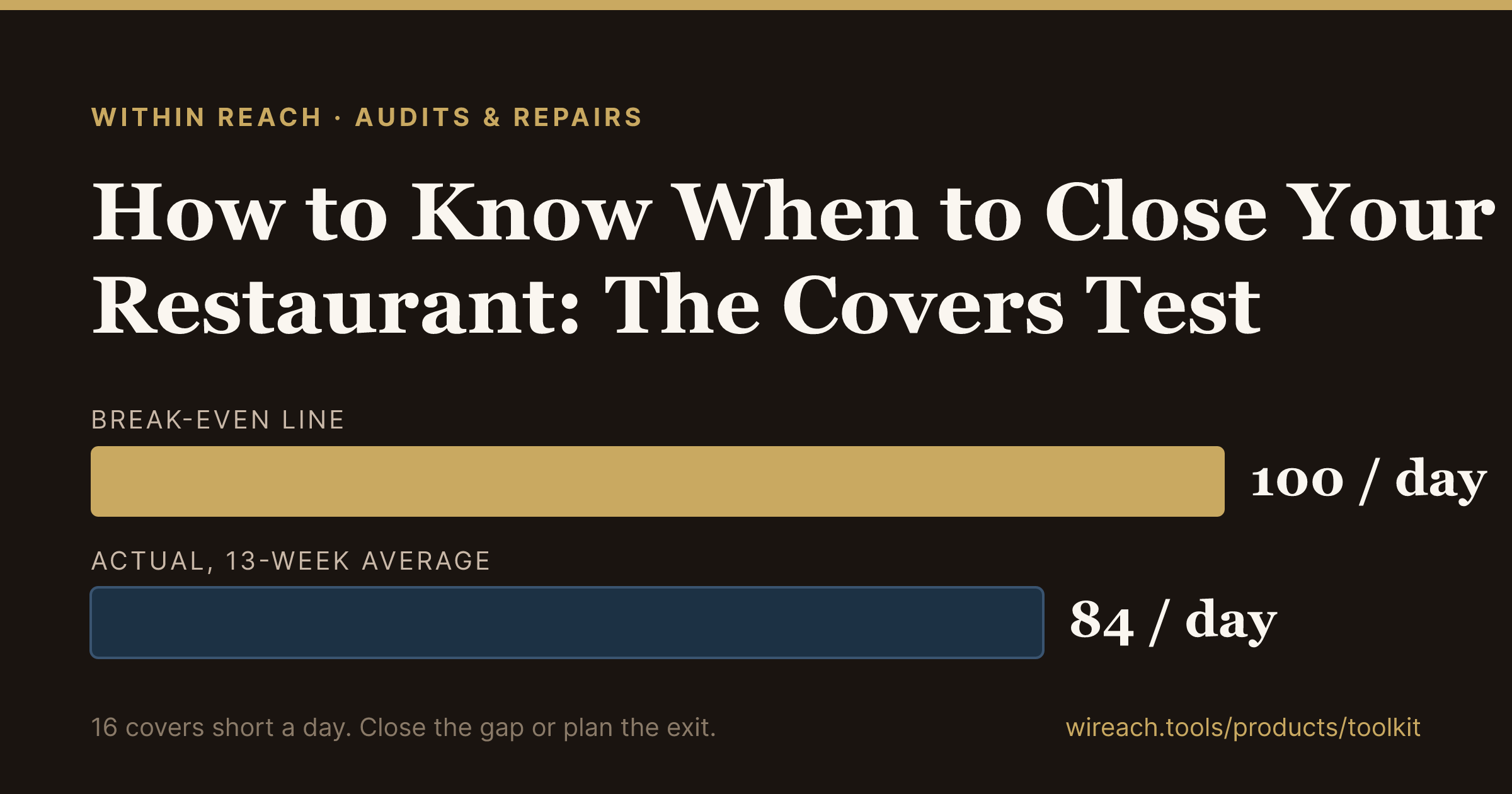
Now the owner looks at an average of 84 covers and thinks, "We are 6 a day from breaking even. One good promo and we are there." The real gap is 16 a day. That is a different conversation.
If you are not getting paid, the restaurant is not breaking even. You are funding it. Put a real salary in, the number you would need to pay a GM to do your job, and run it again.
Count covers every night and compare to the line
One great Saturday hides a lot of slow Tuesdays. The way to see the truth is a nightly count against your break-even line, kept somewhere every manager writes it down.
Pull the last 13 weeks of guest counts from your POS. Average them by open day. In our example the place is doing 84 covers a day. That is 16 short of 100.
Then put the line in front of the team every shift. At close, the manager writes the night's covers, the line, and the difference. When it lives in the shift handoff notes, the opener sees yesterday's gap before the doors open, and nobody can say they did not know. We keep that nightly note, our opening and closing routine, and the LP audits in Audits & Repairs, one mobile app for opening, closing, LP, and R&M, so the count does not live on a sticky note by the register.
Here is the line we use. Copy it into whatever your closers write in:
BREAK-EVEN LINE (paste into tonight's handoff note)
Date: ________   Manager: ________
Covers tonight: ____     Break-even line: ____ (ours: 100 today, 87 if the levers hold)
Difference: + / - ____   Week to date: + / - ____
Average check tonight: $____   (ours: target $25.50)
Biggest reason we missed or beat the line:
______________________________________________
Equipment down or out of product? Y / N   What: ________
Figure out how long the cash lasts
The gap only matters as much as your cash can absorb it. Do this math once, write it on paper, and keep it in your office.
- Covers a month at 84 a day: 84 x 26 = 2,184
- Contribution: 2,184 x $14.40 = $31,449.60
- Fixed costs: $37,440
- Monthly shortfall: $5,990.40
Say there is $24,000 in the bank set aside for this. $24,000 / $5,990.40 is about 4 months of runway. Over a full year at this pace, the shortfall comes to roughly $71,885.
So the honest answer to "can we survive another year" is: not at 84 covers. The question becomes whether you can close the gap in 4 months.
Pull the levers you actually control
You have four: covers, check, variable cost, and fixed cost. Small moves on each stack up. Here is the same restaurant, one lever at a time, then together:
| Change | Each guest leaves | Covers a day to break even |
|---|---|---|
| Starting point | $14.40 | 100 |
| Average check up $1.50 to $25.50 | $15.30 | 95 |
| Variable cost down to 37% | $15.12 | 96 |
| Both together | $16.07 | 90 |
| Both, plus $1,500 a month cut from fixed costs | $16.07 | 87 |
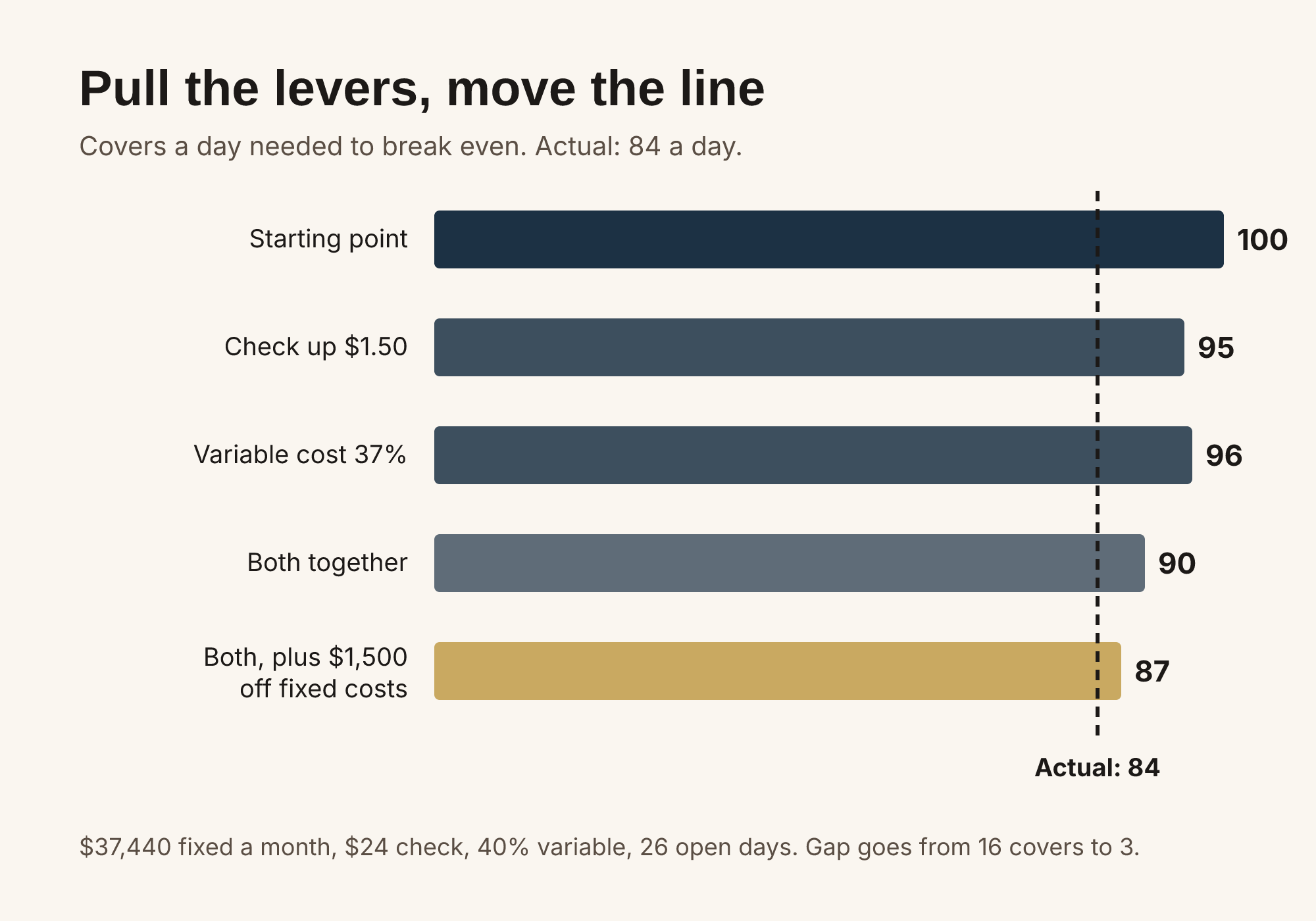 Same restaurant, same 84 covers. Pulling three levers moves the line from 100 to 87.
The gap went from 16 covers a day to 3. Three more guests a day is a reachable goal for a place people already like. Sixteen usually is not, not without a big change to the concept.
Where those points come from on the floor:
- Check. A side or drink suggestion on every order, and a menu price review on your lowest-margin items.
- Variable cost. Waste, over-portioning, and theft, in that order. A weekly LP audit and a look at voids and comps catches more than most owners expect. If you want a tighter read on food and labor together, check your numbers in the free prime cost calculator.
- Fixed cost. Service contracts, subscriptions nobody uses, and equipment you are paying to repair over and over.
What usually goes wrong: cutting the thing that brings guests in
When the numbers get scary, the first move is to cut labor hard. Some of that is right. You should not staff a slow Tuesday like a Friday.
The trap is cutting so deep that service slips. Ticket times climb, the dining room gets dirty, the line runs out of product at 7, and the regulars who were keeping you alive stop coming. Covers drop from 84 to 78, the gap gets wider, and you cut again.
The fix is to cut by daypart, not across the board. Look at covers by hour, staff to the count, and protect the shifts that make your money. Same thing with equipment. A fryer that is down on a Friday costs you covers you cannot get back, so the repair ticket gets chased the same day, not "when the tech can make it."
Run a 90-day test with a decision line
Write this down before day one, sign it, and put it in the office:
- Start and end date. 90 days, on a calendar.
- Targets. Covers a day, average check, variable cost percent. In our example: 87 covers, $25.50, 37%.
- Checkpoints. Every 30 days, average the nightly counts from the handoff notes.
- Decision line. If the 30-day average is still more than a set number of covers under break-even at day 60, you start the exit conversation with your accountant and your landlord. Pick that number now, while you are calm. In our example: more than 3 covers under the new 87 line.
- Cash floor. The dollar amount in the bank where you stop, no matter what the covers say. In our example, $6,000, about one month of the current shortfall.
Lease, loan, and employee-notice obligations when closing vary by contract and by state, so bring your attorney into that conversation too, not just your accountant.
The point of writing it down is that day 60 is a bad day to decide what counts as failing. You will find a reason to keep going. The line you wrote when your head was clear will not.
Keep the count honest every night with Audits & Repairs
Everything above depends on one habit: every manager, every night, writes the covers against the line, flags what broke, and hands it to the next shift. That is the part that slips first when you are tired and the money is tight.
Audits & Repairs puts opening, closing, LP audits, R&M tickets, shift handoff notes, and vendor contacts in one mobile app. Your closer drops the break-even line into the handoff note, logs the fryer that went down, and the opener sees both before the first ticket. When you sit down at day 30, the nightly notes are in one place, not scattered across sticky notes. It is $19 a month with a 14-day free trial, and it is part of the WRI Pro suite.
Run the calculator tonight with your own pay in it. Then start counting against the line tomorrow.
Frequently asked questions
How do I know when to close my restaurant?
Compare your real break-even covers per day to your average actual covers over the last 13 weeks, then divide your cash on hand by the monthly shortfall. If the gap is large, your cash runs out before you can close it, and a 90-day plan with written targets does not move the count, that is the signal to start planning an exit with your accountant.
What are break-even covers for a restaurant?
Break-even covers is the number of guests you need to serve to pay your fixed costs for the period. Take your average check, subtract the variable cost share of it, and divide your monthly fixed costs by what is left. Divide that by your open days to get a daily target.
Should the owner's pay be included in break-even?
Yes. If the owner has stopped taking a paycheck to keep the doors open, the restaurant is not breaking even, the owner is subsidizing it. Put a realistic owner salary into fixed costs so the break-even number reflects what the business actually needs to earn.
How long should I give a struggling restaurant before deciding?
Set a fixed test window, for example 90 days, with written targets for covers per day, average check, and variable cost percent. Track the count every night. A window that ends on a calendar date with numbers written down beforehand keeps the decision honest.
Can a restaurant with great reviews still fail?
Yes. Reviews tell you guests like the food. Break-even covers tell you whether enough of them come in, at a high enough check, to pay the rent and the people. Plenty of well-loved places close because the second number never got watched.