How to Calculate Plate Cost for a Restaurant Menu Item
How to calculate plate cost: price every ingredient by the unit, add up the plate, and set a menu price at your food cost target. Worked burger example.
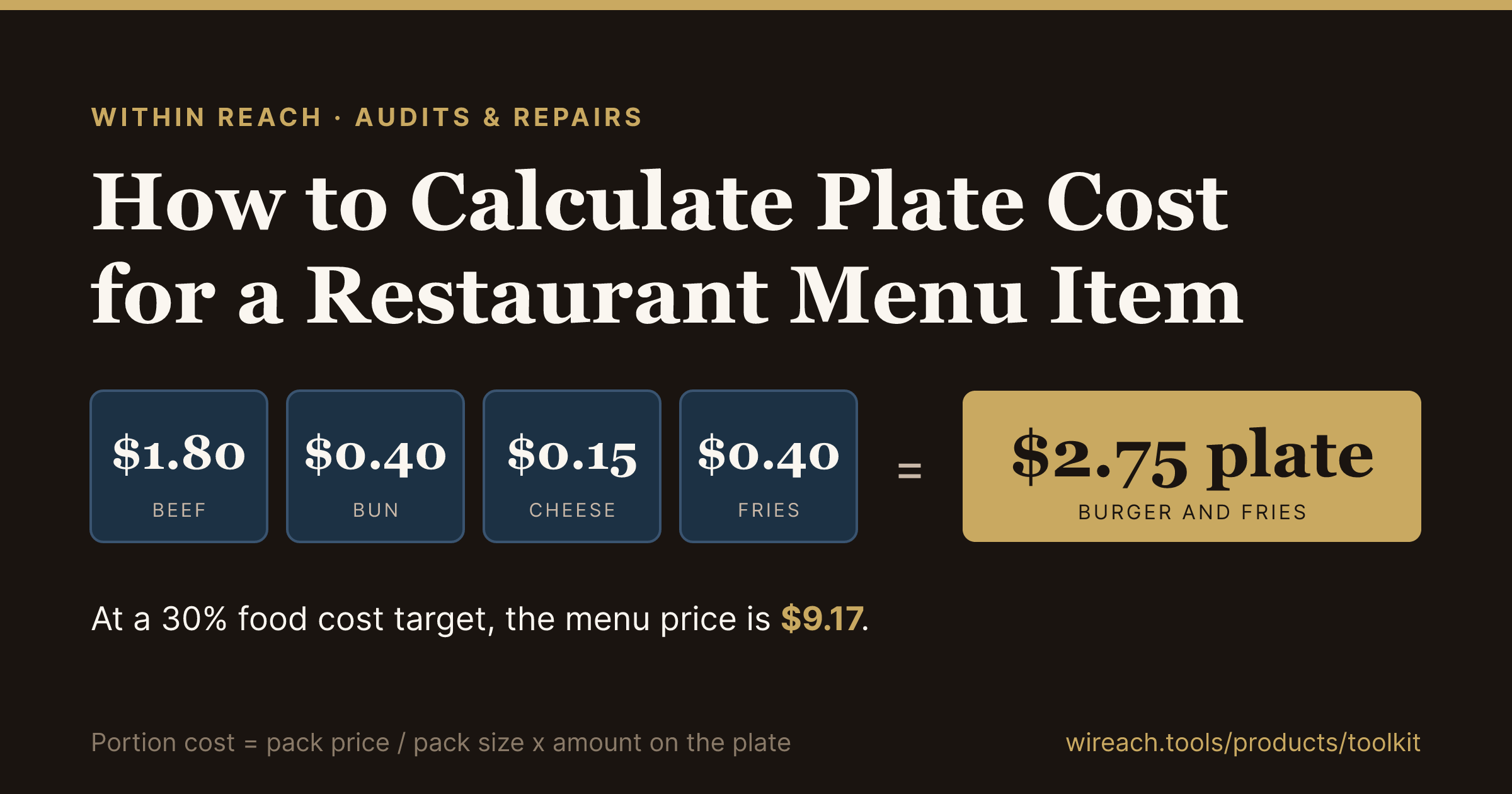
Your best seller can be losing you money every day and still look fine on the menu. The price was set two years ago, beef went up twice since, and the line has been building it with a little extra cheese because that is how the guy who trained them did it.
Learning how to calculate plate cost fixes that, and the math is simpler than most people think. This walks through the formula, one burger and fries plate costed out from start to finish, how to turn plate cost into a menu price, and a costing sheet you can copy for your top 5 items tonight.
The plate cost formula in two lines
Plate cost is what the food on one plate costs you. Not the case, not the week, one plate as it goes in the window.
For each ingredient:
Portion cost = (pack price / pack size) x amount on the plate
Then for the whole plate:
Plate cost = the sum of every portion cost
Pack size and the amount on the plate have to be in the same unit. A 10 lb case of ground beef is 160 oz, so if you portion in ounces, the pack size is 160. Buns come in a pack of 12, so the unit is "each."
To set a price from it:
Menu price = plate cost / target food cost percent
If you would rather skip the long division, cost your plate in the free plate cost calculator. You enter each ingredient, what you pay, and how much goes on the plate, and it gives you the plate cost and the menu price at your target.
A worked example: burger and fries at a 30% target
Here is one plate carried all the way through. These are the same numbers the calculator loads with, so you can check every line against it.
| Ingredient | Pack price | Pack size | On the plate | Portion cost |
|---|---|---|---|---|
| Ground beef | $48.00 | 160 oz | 6 oz | $1.80 |
| Bun | $4.80 | 12 each | 1 | $0.40 |
| American cheese | $3.60 | 24 slices | 1 slice | $0.15 |
| Fries | $32.00 | 480 oz | 6 oz | $0.40 |
| Plate cost | $2.75 |
Line by line:
- Beef: $48 / 160 oz = $0.30 an ounce. Times 6 oz = $1.80.
- Bun: $4.80 / 12 = $0.40.
- Cheese: $3.60 / 24 slices = $0.15.
- Fries: $32 / 480 oz is about $0.067 an ounce. Times 6 oz = $0.40.
Add them up: 1.80 + 0.40 + 0.15 + 0.40 = $2.75 plate cost.
At a 30% food cost target: 2.75 / 0.30 = $9.17 menu price. That leaves about $6.42 per plate after food.
Look at where the money sits. The beef is $1.80 of the $2.75, about 65% of the plate. That is the line to watch. Nobody loses sleep over the cheese.
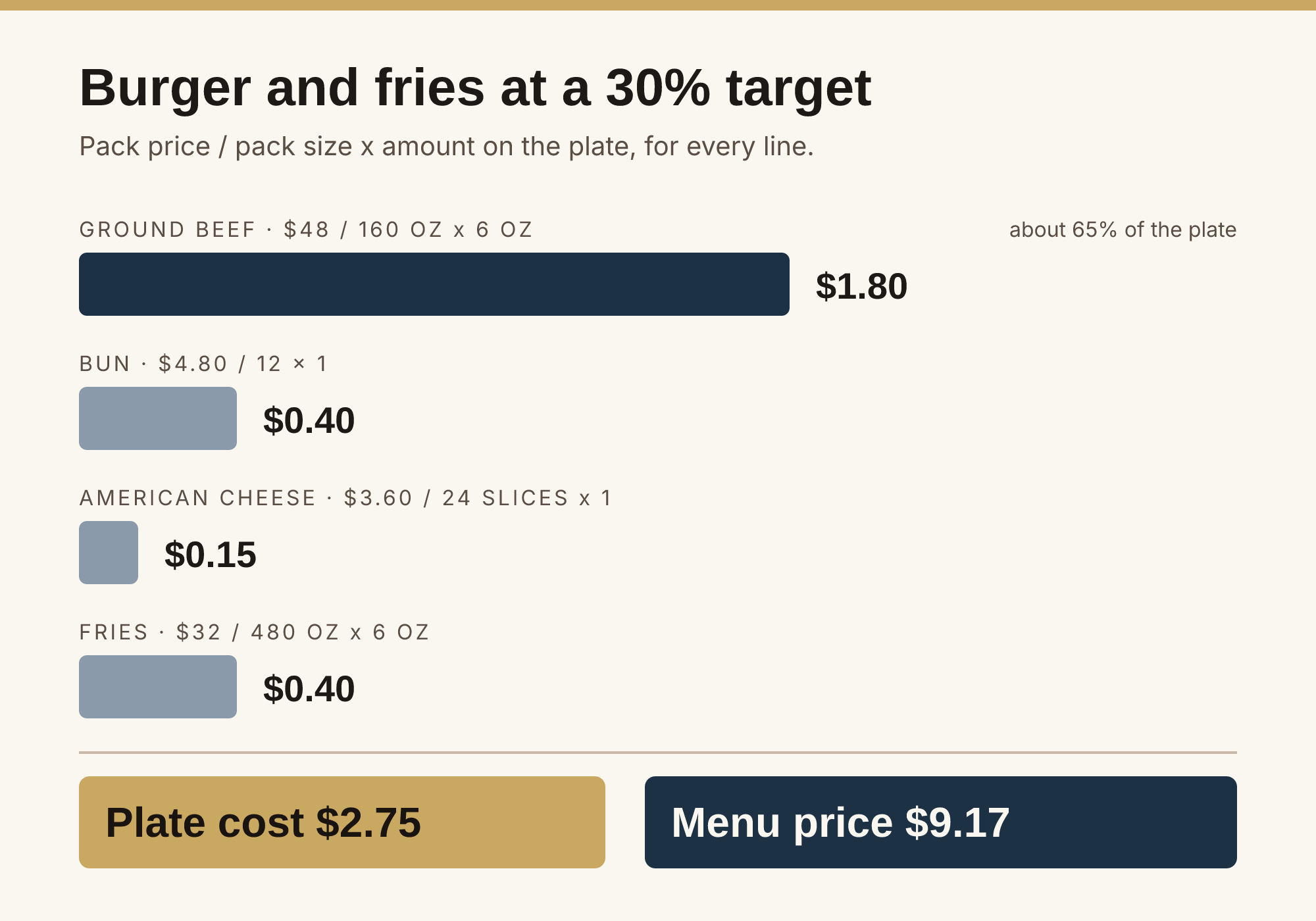 One plate, four ingredients. The beef is most of the cost, so it gets most of the attention.
The number only stays right if the inputs do. When the beef vendor raises the case price, somebody has to catch it, re-cost the plate, and tell the next manager. Keeping your vendor contacts and shift handoff notes in Audits & Repairs means that price change gets written down and passed along instead of living in one person's head.
Count everything that goes out with the plate
Most plate costs come out low because something got left off. If it leaves the kitchen with the plate, it goes on the sheet:
- The side and the sauce. The ramekin of ranch, the pickle spear, the ketchup cup.
- Garnish and oil. The butter on the bun, the oil on the flat top if you portion it.
- Packaging on to-go. If a third of your burgers ship in a clamshell with a sauce cup and a bag, that is part of the plate.
- Trim and cook loss. If the item loses weight before it hits the plate, the usable ounce costs more than the invoice ounce. Run anything you trim or cook down through the yield calculator for raw versus usable weight, then use the usable amount as your pack size.
Small items look like rounding errors. A 10 cent sauce cup on every plate is a real number by the end of the month.
Turn plate cost into a price you can print
The calculator gives you the price that hits your target. That is the floor of the conversation, not the final answer.
- Pick a target that fits the item. Commonly cited ranges run about 25% to 35% for most full service menus. Proteins tend to run higher, fries and drinks run lower. The whole menu has to average out, not every plate.
- Round to a real menu price. $9.17 does not go on a menu. At $9.49, the same $2.75 plate runs about 29% food cost. At $8.99 it runs about 31%.
- Check it against the street. If the place down the road sells a burger and fries for $8, you need a reason a guest pays more, or a cheaper plate.
- Write the date on it. A plate cost without a date is a guess about some week in the past.
If you want to see how the full menu stacks up, the restaurant food cost statistics roundup has the broader numbers in one place.
What usually goes wrong
The math is not the problem. The kitchen drifting away from the math is. Here is what that looks like on a real line:
- Heavy portions. The recipe says 6 oz. The patty press makes 7. That extra ounce is $0.30 a plate. Sell 300 burgers a week and that is $90 a week walking out the window on one item.
- The extra slice. Somebody starts doubling the cheese because a regular asked once. That is another $0.15 a plate nobody priced in.
- The vendor price moved and nobody re-costed. Say the beef case goes from $48 to $54. Beef on the plate goes from $1.80 to about $2.03, the plate goes to about $2.98, and your $9.17 burger is now running about 32% food cost. Same menu, same price, less money.
- Costing from the recipe card instead of the line. Watch the plate get built during a rush and weigh it. That is the plate you are actually selling.
This is how I look at it as a GM:
I don't look at plate cost just to see if the math works. I'm looking at whether we're actually making the money we think we're making.
A recipe can look profitable on paper and still lose margin every day. Portions get heavy. Vendor prices change. Prep waste gets ignored. Somebody adds an extra ounce of cheese or another piece of protein, and nobody thinks much about it because it doesn't look like a big deal.
Multiply that by hundreds of plates and it becomes a big deal.
That's why I want to know the cost of every ingredient and what the plate should cost before I decide what to charge.
The calculator gives me the food cost. My job as the GM is making sure what's leaving the kitchen matches what's on the screen.
A plate costing sheet you can copy tonight
Start with your top 5 sellers. Those are where a few cents a plate turns into real money.
| Item | Ingredient | Pack price | Pack size | Unit | On the plate | Portion cost |
|---|---|---|---|---|---|---|
| Burger and fries | Ground beef | $48.00 | 160 | oz | 6 | $1.80 |
| Plate cost | ||||||
| Target % | ||||||
| Menu price | ||||||
| Date costed |
How to use it:
- Pull the latest invoice for each ingredient. Not last quarter's, the latest one.
- Make sure pack size and portion use the same unit before you divide.
- Weigh 3 plates off the line during service and use the average portion, not the recipe card.
- Add every line for the plate cost, then divide by your target to get the price, or check each plate against the plate cost calculator when you are done.
- Re-cost any item whenever a main ingredient price moves, and look at your top 5 once a month.
Keep the numbers from drifting
Costing a plate takes ten minutes. Keeping it honest takes every manager on every shift noticing when a vendor price moves or a portion starts creeping, and passing it along before the next truck.
Audits & Repairs keeps opening, closing, LP audits, R&M tickets, shift handoff notes, and vendor contacts in one mobile app. When the beef price jumps or the closer notices the patties running heavy, it goes in the handoff notes and the next manager sees it. It is $19 a month with a 14-day free trial, so you can run it for two weeks of shifts and see whether price changes and heavy portions stop slipping through.
Frequently asked questions
How do you calculate plate cost for a menu item?
For each ingredient, divide what you pay for the pack by how many units are in it, then multiply by how many of those units go on one plate. Add every ingredient together and that total is your plate cost.
How do you get a menu price from plate cost?
Divide the plate cost by your target food cost percent written as a decimal. A $2.75 plate at a 30% target is 2.75 divided by 0.30, which is $9.17. Then round to a price that makes sense on your menu.
What is a good food cost percentage for a menu item?
Commonly cited ranges run from about 25% to 35% for most full service menus. Proteins like steak often run higher and items like fries or drinks run lower, so look at the whole menu, not one plate.
Should plate cost include trim and waste?
Yes. If part of the case gets trimmed or cooks off before it hits the plate, the usable ounces cost more than the invoice says. Use the usable amount as the pack size, or raise the portion to cover the loss.
How often should I recalculate plate cost?
Any time a vendor price moves on a main ingredient, the recipe or portion changes, or the item goes on a new menu. A quick check on your top sellers once a month catches most of the drift.