How to Divide Tips by Hours Worked (Tip-Out Math With an Example)
How to calculate tip-outs by hours worked: the exact formula, a worked 1,420 dollar example, role weighting, and a worksheet you can copy tonight.
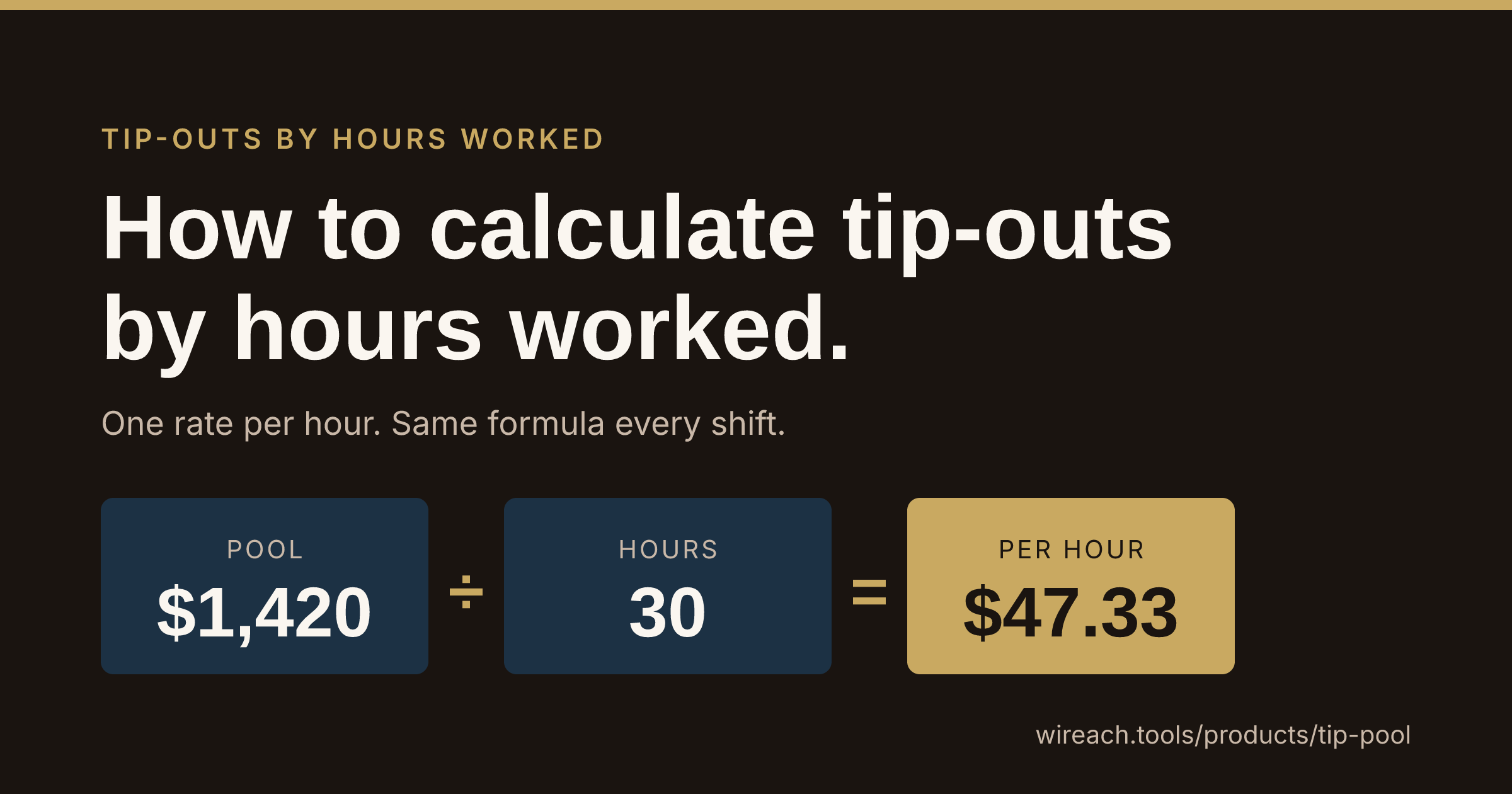
To divide tips by hours worked, add up everyone's hours, divide the pool by that total to get a per-hour rate, and multiply each person's hours by that rate. A 1,420 dollar pool over 30 hours is 47.33 an hour, and the free tip pool calculator does it to the penny.
Splitting tips by hand at the end of a long shift is how trust on a team quietly breaks. The drawer is counted, everyone is tired, and one server is already sure the math went against them. Do that two or three nights running and you have a morale problem that was never really about the money.
Calculating tip-outs by hours worked fixes most of it, as long as you run the same formula every shift and write it down. Below is the exact math on a sample 1,420 dollar night, the role-weighted version many full-service teams end up using, a worksheet you can copy tonight, and the spots where the by-hand version falls apart.
Why hours worked is the fairer base
An even split treats a 4-hour shift and an 8-hour close the same way. They are not the same. The person who stayed through the rush and the side work earned more of that pool, and an even split quietly takes it from them.
Splitting by hours lines each payout up with the time actually worked. It is simple to explain, and "you got paid for the hours you put in" is an argument nobody loses.
Pick your method before the shift, not after
You have two clean options. Choose one and post it where the team can read it.
- Equal per hour. Every tipped hour is worth the same dollar amount. Easiest to run and the easiest to defend.
- Role weighted. Each position gets a set share of the pool, and that share splits by hours inside the role. It rewards both the position and the time on the floor.
The rule that matters more than which one you pick: do not change it mid-week. Adjusting the formula after a good night is the fastest way to lose the room. Whichever you choose, set it once and let the Tip Pool Calculator run the same hours-weighted split every night so every closer runs the same math.
The equal-per-hour math, step by step
Here is a typical Monday: 1,180 dollars in card tips and 240 cash, so a 1,420 dollar pool. Five people worked 30 tipped hours between them.
- Add every tipped employee's hours. 7.5 + 6 + 7 + 5.5 + 4 = 30.
- Divide the pool by total hours. 1,420 / 30 = 47.333 per hour. Keep the extra decimals until the end.
- Multiply each person's hours by the rate, then round.
That gives you:
- Marcus, 7.5 hours: 355.00
- Dana, 6 hours: 284.00
- Luis, 7 hours: 331.33
- Priya, 5.5 hours: 260.33
- Sam, 4 hours: 189.33
Now add them back up. You get 1,419.99, one cent short of the pool. That cent goes to the longest shift, so Marcus gets 355.01, and you write "1 cent to longest shift" on the sheet. That reconciliation step is the one people skip, and it is the one that keeps the night honest. If you want to check a night before you pay it out, the free tip pool calculator does the hours math to the penny.
Role weighting, the version many full-service teams land on
Same 1,420 dollar night. This time you set role shares first: servers 60 percent, bartender 20 percent, busser 12 percent, runner 8 percent.
- Split the pool by role share. Servers 852.00, bartender 284.00, busser 170.40, runner 113.60.
- Inside each role, split that share by hours. The two servers worked 7.5 and 6, so 13.5 server hours. Marcus gets 7.5 of 13.5 of the 852, which is 473.33. Dana gets 6 of 13.5, which is 378.67.
The full split:
- Marcus, server, 7.5 hours: 473.33
- Dana, server, 6 hours: 378.67
- Luis, bartender, 7 hours: 284.00
- Priya, busser, 5.5 hours: 170.40
- Sam, runner, 4 hours: 113.60
That adds back to exactly 1,420.00. Notice what changed: Luis worked more hours than Dana but takes home less, because the bartender share is fixed at 20 percent. That is the trade you are making with role weighting, and the team needs to hear it from you before payday, not discover it on their stub.
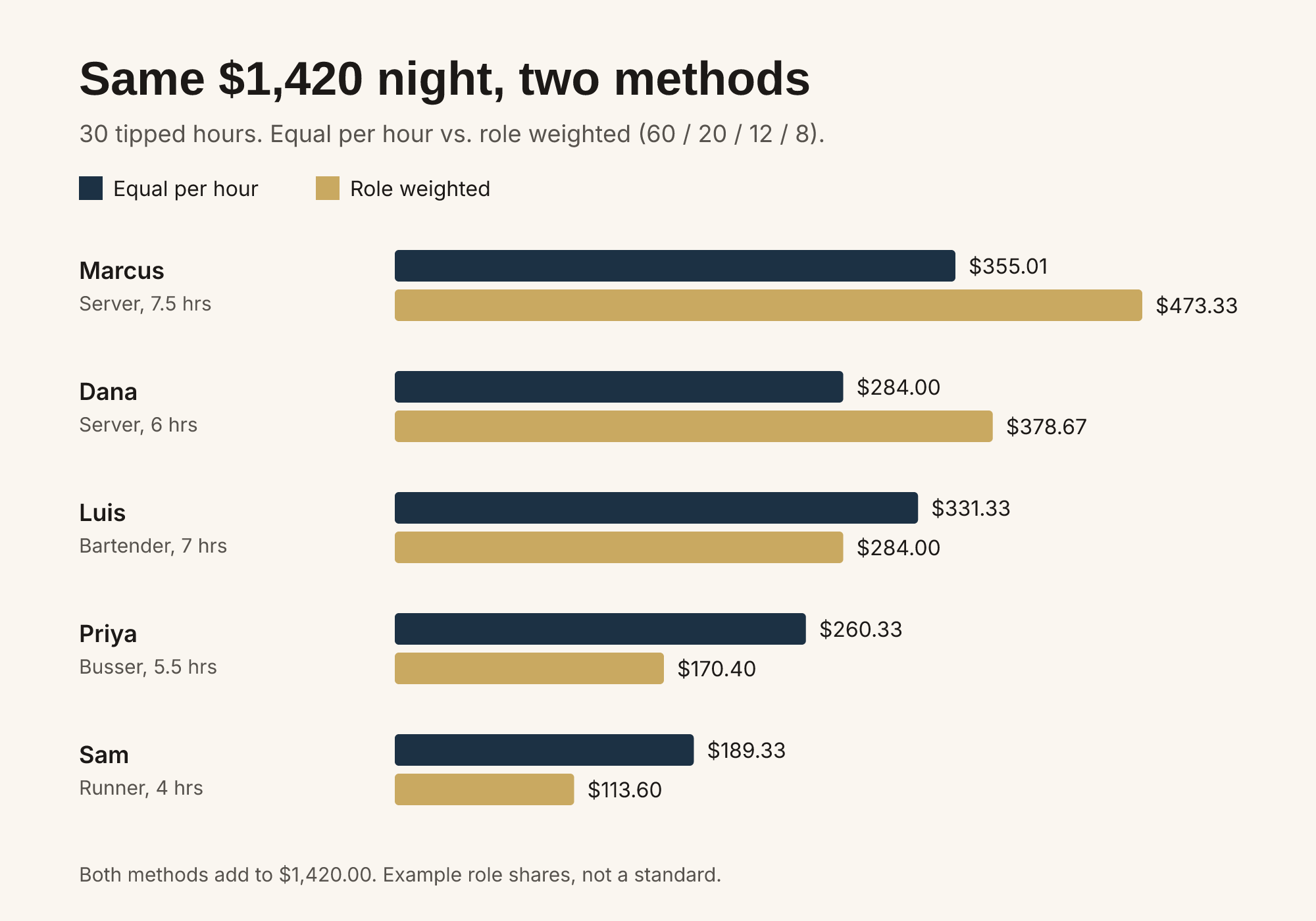 Same night, same hours, two methods. Servers gain, support roles give back.
Those percentages are an example, not a standard. Set your own once, write them down, and leave them alone.
What actually goes wrong on the floor
The formula is rarely the problem. The inputs are. After a lot of years closing restaurants, these are the ones that start the fights:
- The early clock-in. A bartender clocks in 40 minutes early to "set up" and nobody approved it. Those 40 minutes come straight out of everyone else's share. Decide what counts as tipped time and put it in writing.
- The early cut who stays on the clock. Somebody gets cut at 8:30 and forgets to punch out until 9:15. Fix the punch before you run the math, not after the payouts are posted.
- Tired arithmetic. Doing this from memory at 1 a.m. is where most disputes start. Same sheet, same order, every night.
- No record. When a payout gets questioned two weeks later, you want the inputs and the result on paper, not in your head.
Most of this is policy, not math. If you are still writing that policy, our guide on running a restaurant tip pool without the drama walks through it, including the parts to confirm with your labor counsel.
A tip-out worksheet you can copy tonight
Paste this into a sheet or print it for the closing binder. Same shape every night is the whole point.
TIP-OUT WORKSHEET   Date: __________   Closing manager: __________

Card tips: $ ________   Cash tips: $ ________   Total pool: $ ________
Method (circle): equal per hour  /  role weighted

EQUAL PER HOUR
Total tipped hours tonight: __________
Per-hour rate (total pool / total hours): $ __________

Name            Role         Hours    Payout (hours x rate)
___________     _________    _____    $ __________
___________     _________    _____    $ __________
___________     _________    _____    $ __________
___________     _________    _____    $ __________
___________     _________    _____    $ __________

Sum of payouts: $ __________     Matches total pool? Y / N
Rounding remainder: ______ cents, went to: __________
Punches corrected before math? Y / N   Who approved: __________
A quick word on the rules
Who is allowed in a tip pool, and how tipped wages work, is set by federal and state law. It changes, and it is contested in some states right now. The math above is operational, not legal. Confirm the current rules for your state with your labor counsel or your state labor agency before you rely on any policy.
Stop running this in a notebook at 1 a.m.
Everything above, the per-hour rate, the role shares, the final split, is what the Tip Pool Calculator does in about three taps. Enter the night's card and cash tips, add who worked with their role and hours, and it returns every payout. Hours-weighted or a flat split by role, your call. Each shift saves to history, and you can export it to CSV when payroll or an owner wants to see it.
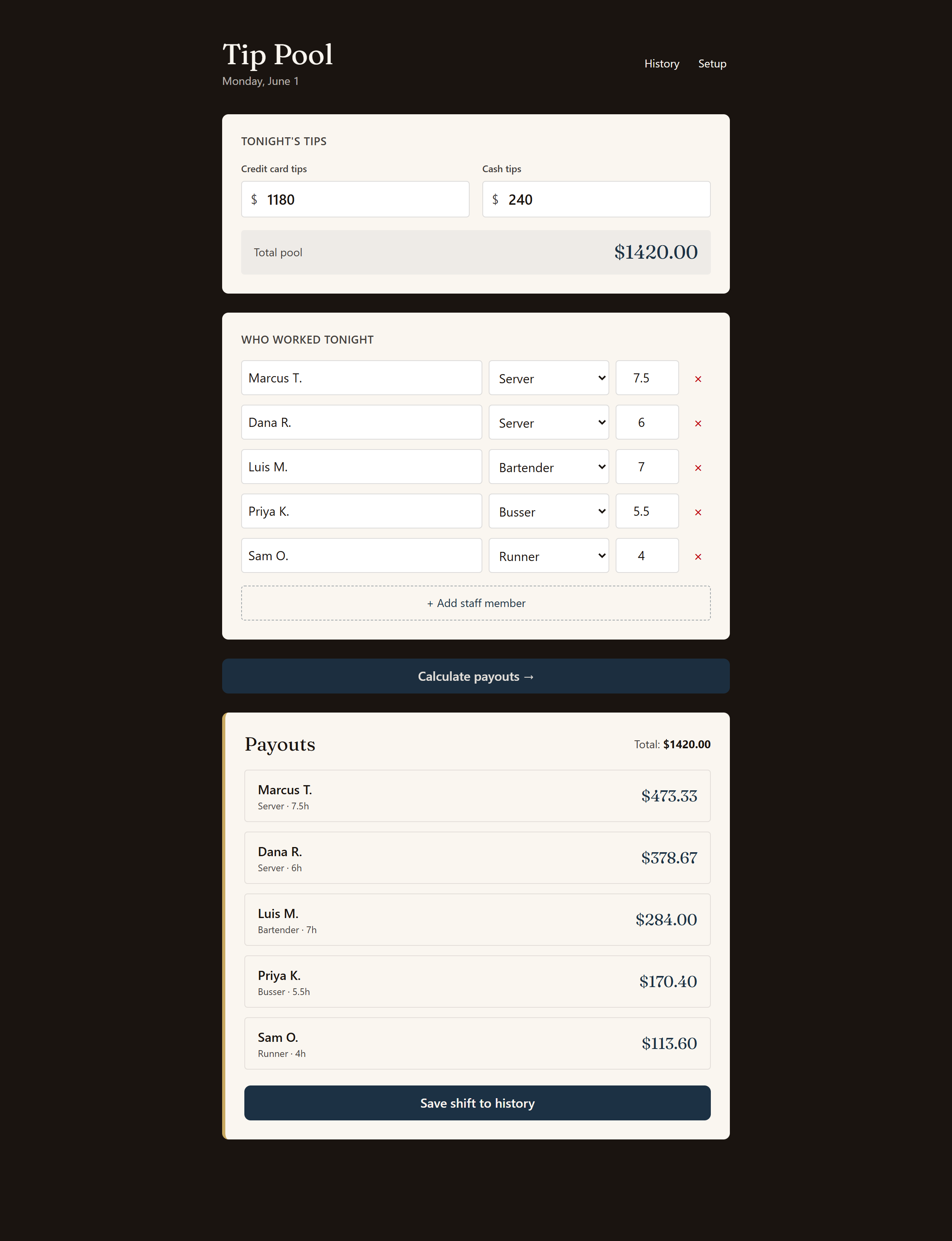 Tonight's 1,420 dollar pool, entered and split in one screen
It is $9 a month with a 14-day free trial, and it is part of the WRI Starter suite if you want the Par Level Tracker alongside it.
Frequently asked questions
How do you calculate tip-outs by hours worked?
Add up every tipped employee's hours for the shift, divide the total tip pool by those hours to get a per-hour rate, then multiply each person's hours by that rate. A 1,420 dollar pool over 30 hours is 47.33 an hour, so someone who worked 7.5 hours takes home 355 dollars.
What do I do with leftover cents after rounding tip-outs?
Round each payout at the very end, add them back up, and compare to the pool. If a cent or two is left over, give it to the longest shift and write down that you did. The written rule matters more than the penny.
Is it fairer to split tips evenly or by hours worked?
Hours worked is usually seen as fairer, because the person who stayed through the close earns more of the pool than someone who left after the rush. Many full-service teams add role weighting on top so positions with more guest contact get a larger share.
What is role-weighted tip pooling?
Role-weighted pooling gives each position a set percentage of the pool, for example servers 60 percent and bartender 20 percent, then splits each position's share among its people by hours worked. It accounts for both the role and the time on the floor.
Who is allowed to be in a tip pool?
That is set by federal and state law, it changes over time, and it is contested in some places. Confirm the current rules for your state with your labor counsel or your state labor agency before you rely on any policy.