How to Run a Restaurant Tip Pool Without the Drama
How to run a restaurant tip pool that staff trust and auditors can follow. Step-by-step policy, math, and reporting from a working GM.
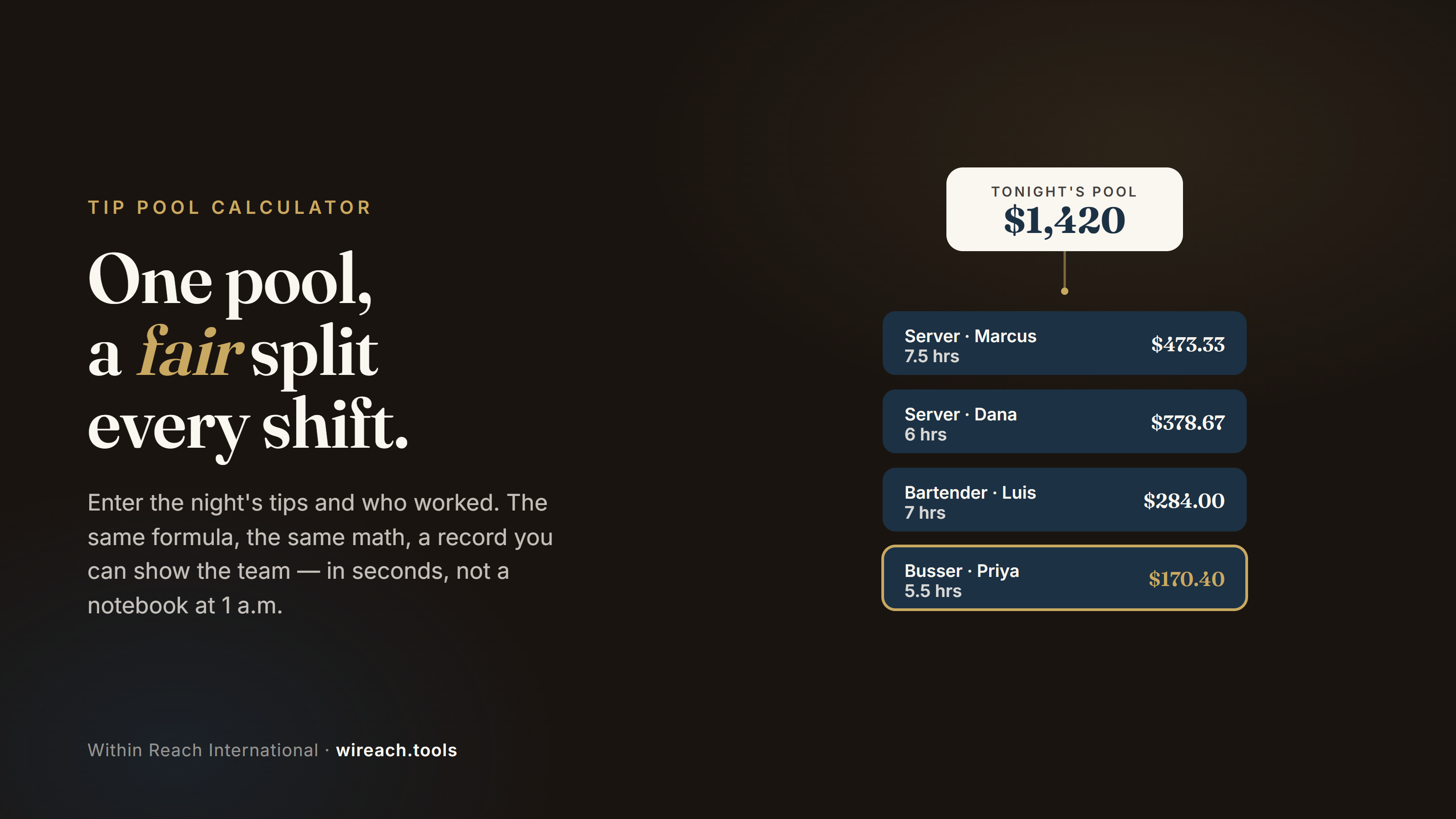
Tip pools fall apart in the same way every time. The closing manager is doing fifth-grade math on a receipt at 1am, somebody's hours got typed in wrong, a server who closed alone feels shorted, and by Tuesday two people are in your office with their phones out.
The math is not the hard part. The hard part is doing it the same way every shift, paying it out fast, and keeping a record you can show the team (or a state auditor) without scrambling.
Here is how I run it. None of this is legal advice, and the rules on who can be in a pool and how tipped wages work change. Pin that down with your labor counsel or state agency first. After that, the operational side is the same wherever you are.
Decide what kind of pool you are running
Pick one of these before the next shift. Do not mix them.
- Hours-based pool. Add up all the tips for the shift. Add up all the tipped hours for everyone in the pool. Divide tips by hours to get a per-hour rate. Pay each person their hours times that rate.
- Points-based pool. Assign a point value to each role (for example, server = 10, bar = 10, runner = 6, busser = 5). Add up everyone's points for the shift. Divide tips by total points. Pay each person their points times that rate.
- Fixed percentage tip-out. Servers keep their own tips and pay out a fixed percentage to support roles. Cleanest for full-service rooms with stable sections. Messy if sections are uneven.
Hours is the easiest to explain. Points is fair when one role works visibly harder than another. Percentage works when servers want to control their own outcome. None of them are wrong. The one you pick is the one you commit to.
Write the policy down before the first shift uses it
A tip pool that lives in the GM's head is a lawsuit. A tip pool that lives on a piece of paper everyone signed is a policy.
The policy should answer, in writing:
- Who is in the pool and who is not.
- What the formula is (hours, points, or percentage with the actual numbers).
- What counts as a tipped hour (clocked in on the floor? side work?).
- What happens to credit card tips vs cash.
- When tips are paid out and on what schedule.
- Who does the math and who reviews it.
- What happens if someone disputes a payout.
Have every tipped employee sign it on hire and again when you change anything. Keep the signed copies. Two pages is enough.
Track hours and tip-eligible time accurately
Garbage in, garbage out. The biggest fights I have seen on tip pools came from a clock-in that was off by 45 minutes, not from anyone trying to cheat.
A few rules that prevent most of it:
- Clock-in and clock-out must happen on the POS, not on a paper sheet "to be entered later."
- Anyone who clocks in early without permission gets clocked out and re-clocked at the scheduled time. Write this into the policy.
- Salaried managers do not count toward tipped hours. Ever. This is the line you do not blur.
- If someone leaves the floor for a long pre-shift meeting or a long break, decide in advance whether that time counts. Document the call.
If your POS exports time punches as a CSV, you are 80% of the way to a clean pool. If it does not, fix that before you fix anything else.
Do the math the same way every shift
The closing manager should not be inventing the formula at 12:45am. They should be plugging numbers into the formula you already wrote down.
Here is the basic hours-based math, in the order you do it:
- Pull the credit card tips total from the POS.
- Count the cash tips the team is turning in (or the declared cash tip total, depending on your setup).
- Subtract any house-kept fees or processing deductions if your policy allows them. Be careful here. This is where state rules vary and where staff will read the policy hardest.
- That is your pool total.
- Pull each person's tipped hours from the POS.
- Divide pool total by total tipped hours = per-hour rate.
- Multiply each person's hours by the rate. That is their payout.
- Round to the nearest cent. Round-down differences (the pennies left over) go to a documented bucket (next shift's pool, a charity, whatever the policy says). Do not let the closer pocket them.
The points version is the same, just swap "hours" for "weighted points" in steps 5 through 7.
This is also the step where the Tip Pool Calculator does its real work. Once you have your formula written down, the calculation should take seconds, not 20 minutes of a manager bent over a receipt.
Pay out within the pay period and show the breakdown
Whatever you decide on payout timing, do it on schedule and show the math.
Two patterns that work:
- Same-day cash payout. Cash tips go out at the end of the shift. Credit tips go on the paycheck as a separate line. Staff see what they earned that night.
- Same-paycheck payout. All pooled tips, cash and credit, hit the paycheck under a clearly labeled line. Slower, but cleaner for accounting.
Either way, the staff member should be able to look at their stub, see "Tip Pool Distribution: $X.XX for shift on May 28," and tie it back to a record you keep. If they cannot, you have a trust problem waiting to happen.
Copy-paste tip pool policy snippet
Use this as a starting point. Edit the bracketed parts to match your operation. Run it past your labor counsel before you put it in front of staff. Confirm the eligibility rules for your state.
TIP POOL POLICY — [Restaurant Name]
Effective: [Date]

1. Eligibility. The following roles participate in the tip pool: [list roles].
   Salaried management does not participate. Eligibility for any role may be
   adjusted only with written notice and re-signature.

2. Pool composition. The pool includes [credit card tips / cash tips /
   service charges as defined below] earned during the shift.
   It does not include [list exclusions].

3. Distribution method. Tips are distributed by [hours worked /
   points-by-role / fixed percentage]. The current formula is:
   [exact formula, with numbers].

4. Tipped hours definition. Tipped hours are hours clocked in on the POS
   in a tipped role on the floor. [Define meeting time, side work,
   and break treatment here.]

5. Payout schedule. Tips are paid out [same-shift cash / on the paycheck
   covering the pay period in which earned]. Paychecks list pooled tips
   as a separate line item.

6. Records. Daily pool totals, individual hours/points, the formula used,
   and individual payouts are recorded and retained for at least
   [retention period].

7. Disputes. Any team member who believes their payout is incorrect should
   raise it to the GM within [X days]. The GM will review the records and
   respond in writing within [Y days].

8. Changes. This policy may only be changed with written notice to all
   tipped employees, and re-signature before the change takes effect.

Signed: ____________________________   Date: ______________
Stop doing tip pool math on a receipt
This is the part the Tip Pool Calculator handles. You put in the pool total and the hours or points, and it gives you Fair, fast, audit-proof tip distribution. Every shift gets a record that ties back to the formula you wrote down, so when somebody asks why their number is what it is, you have an answer in two clicks instead of a notebook search.
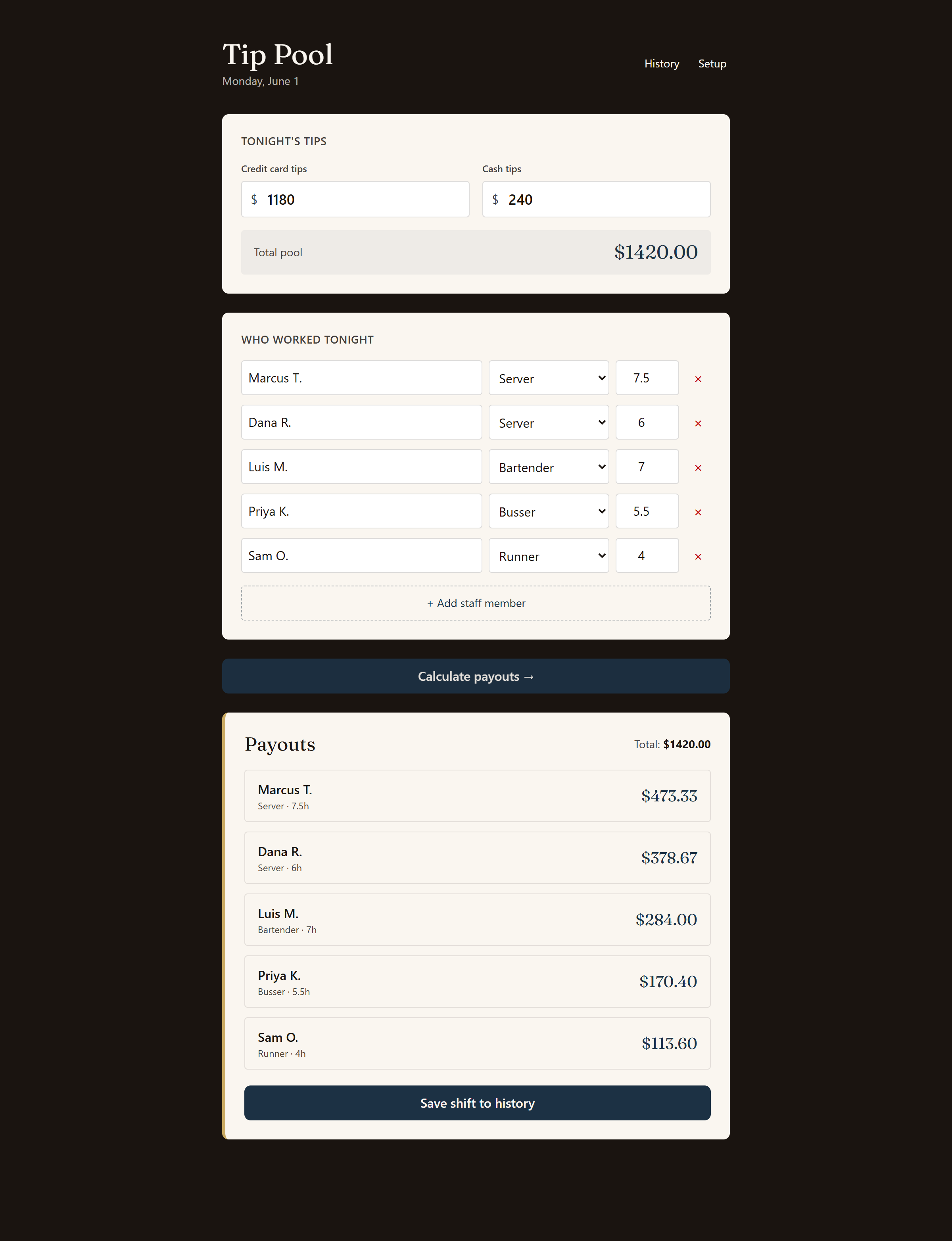
See the Tip Pool Calculator. It is part of the Starter suite, which is where most operators start when they want to get the basics under control without buying the whole stack.
If clean tip pools are a problem, attendance and prep usually are too. The No-Show Tracker catches the patterns that turn into a short shift, and Daily Ops makes the shift report run itself so the closing manager is not doing three jobs at midnight.
One more thing on trust
The tip pool is one of the few things in a restaurant where every person on the floor knows, to the dollar, whether you got it right. You will not bluff your way through this one. Pick a method, write it down, do it the same way every shift, and show the math. The team will trust the system long before they trust the manager running it, and that is fine. That is what a clean pool buys you.
Frequently asked questions
What is a restaurant tip pool?
A tip pool is a system where some or all tipped employees combine their tips for a shift, then split the total based on a written rule (usually hours worked, points, or a fixed percentage). It is meant to make pay more even across a shift and reward back-of-pool roles that help drive service.
Who can legally be in a restaurant tip pool?
Rules on who can be in a tip pool, and how tipped wages work, are set by federal and state law, change over time, and are currently contested in places. Confirm the current rules for your state with your labor counsel or state labor agency before you build your pool. The operational steps in this guide apply once you know who is eligible at your location.
Should I pool by hours or by points?
Hours is simplest and easiest for staff to understand: total tips divided by total tipped hours, times each person's hours. Points lets you weight roles differently (server vs runner vs busser). Pick one method, write it down, and use it every shift. The fastest way to lose trust is changing the formula mid-week.
How often should tips be paid out?
Pay tipped earnings within the same pay period they were earned, on a predictable day. Same-day cash payout works if your cash flow supports it. Otherwise add the pooled tips as a separate line on the paycheck so staff can see exactly what they earned per shift.
What records do I need to keep for a tip pool?
At minimum, keep the daily tip pool total, hours or points per employee, the formula used, the amount paid to each person, and the date paid. Keep them somewhere that is not a notebook the closing manager takes home. A spreadsheet or a calculator that exports a record is enough for most audits.
What is the biggest mistake operators make with tip pools?
Two: doing the math by hand on a busy night (which leads to errors and arguments), and changing the rules without telling the team. Both kill trust faster than anything else. A written policy and a consistent calculation method fixes 90% of the friction.