Tip Pooling vs Tip Sharing: How the Math Differs
Tip pooling vs tip sharing, run on the same Friday night with real numbers, so you can see exactly who takes home more under each method.
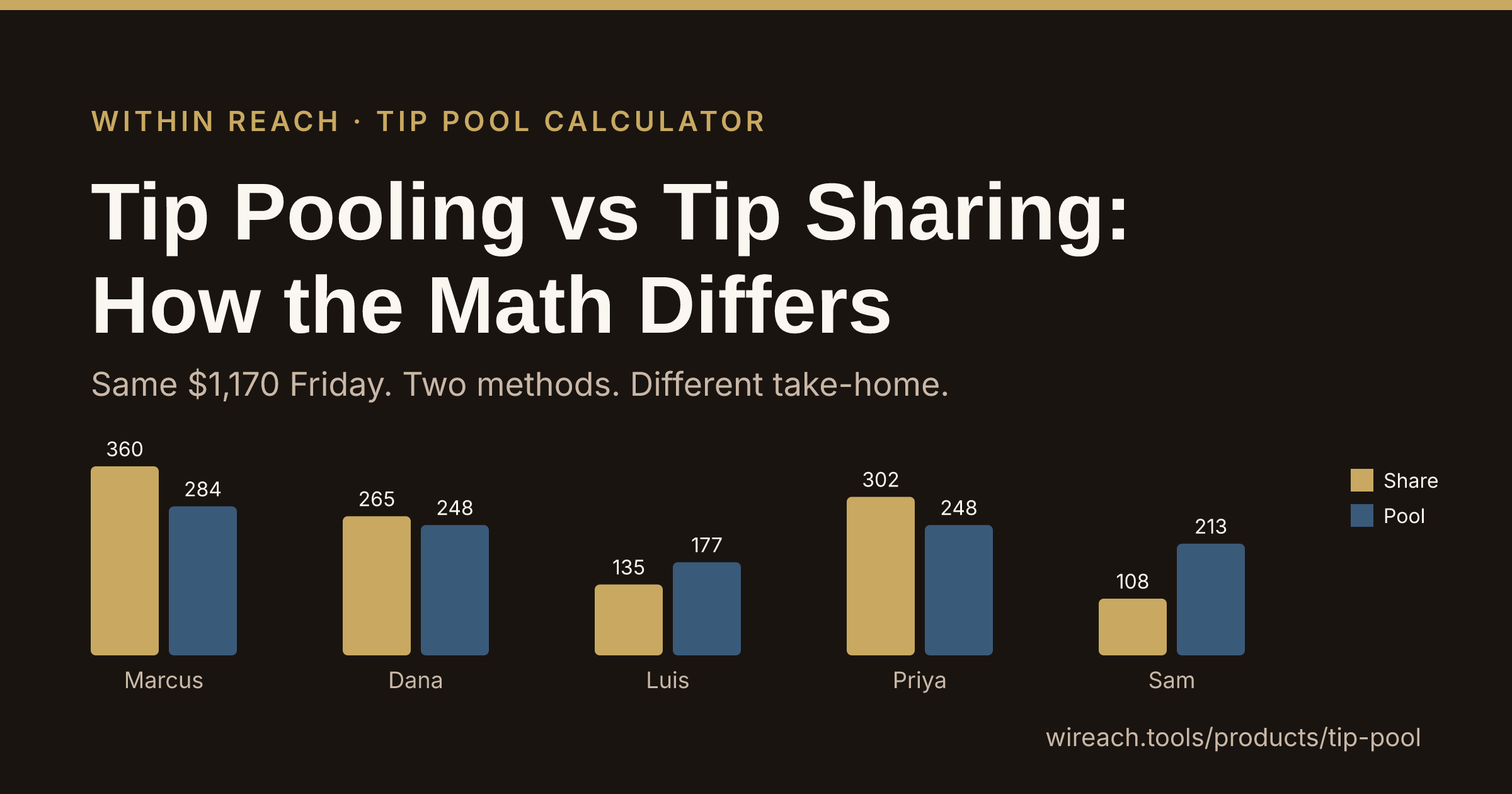
Your best server walked out Friday with 360 dollars and your busser walked out with 108. Switch that same night to a tip pool and the server drops to 283.64 and the busser jumps to 212.73. Nobody worked harder or slower. The only thing that changed was the method.
That is the whole tip pooling vs tip sharing argument in two numbers. Most owners pick one because it is what the last place did, then spend a year answering "why did I get less" questions they cannot explain.
Below is one Friday night run both ways, step by step, so you can see where every dollar goes and pick the method that fits how your floor actually works.
The one-sentence difference
Tip sharing: each server keeps their own tips and pays a set slice to the people who supported them.
Tip pooling: every tip goes into one pot, and the pot gets divided back out by a formula.
Sharing works bottom-up from what each person earned. Pooling works top-down from what the team earned. Everything else in this article is just what that looks like on a closeout sheet.
Here is the Friday we will run both ways. Five people, 1,170 dollars in tips:
| Person | Role | Sales | Own tips | Hours |
|---|---|---|---|---|
| Marcus | Server | 2,400 | 480 | 8 |
| Dana | Server | 1,900 | 360 | 7 |
| Luis | Server | 1,100 | 190 | 5 |
| Priya | Bartender | n/a | 140 | 7 |
| Sam | Busser | n/a | 0 | 6 |
Total tips: 480 + 360 + 190 + 140 = 1,170 dollars. Total hours: 33.
How tip sharing math works
Say your tip-out policy is 3% of sales to the bar and 2% of sales to the busser. The math runs off each server's sales, not their tips:
- Marcus: bar 2,400 x 0.03 = 72. Busser 2,400 x 0.02 = 48. Keeps 480 - 72 - 48 = 360.
- Dana: bar 57, busser 38. Keeps 360 - 95 = 265.
- Luis: bar 33, busser 22. Keeps 190 - 55 = 135.
- Priya: her own 140 plus 72 + 57 + 33 from the servers = 302.
- Sam: 48 + 38 + 22 = 108.
Check it: 360 + 265 + 135 + 302 + 108 = 1,170. Every dollar is accounted for.
Notice what sharing does. Marcus had the best section and he keeps the best night. Luis had a light section and he feels it. Sam lives entirely on what three servers remember to hand him at close.
How tip pooling math works
Now take the same 1,170 and put it in one pot. The simplest pool is straight hours:
- Pool total: 1,170 dollars.
- Total hours: 8 + 7 + 5 + 7 + 6 = 33.
- Per-hour rate: 1,170 / 33 = 35.4545 dollars.
- Multiply each person's hours by the rate:
- Marcus: 8 x 35.4545 = 283.64
- Dana: 7 x 35.4545 = 248.18
- Luis: 5 x 35.4545 = 177.27
- Priya: 7 x 35.4545 = 248.18
- Sam: 6 x 35.4545 = 212.73
Add them back: 1,170.00 exactly. If your rounding ever leaves a cent over or under, give it to the longest shift and write that on the sheet. This is the same hours math our guide on calculating tip-outs by hours worked walks through in more depth.
A lot of floors do not want the busser earning more per hour than a server, so they add role weights. Server and bartender at 1.0, busser at 0.5. Multiply hours by weight to get points: 8 + 7 + 5 + 7 + 3 = 30 points. One point is worth 1,170 / 30 = 39 dollars. Payouts: Marcus 312, Dana 273, Luis 195, Priya 273, Sam 117. Still 1,170 total.
That is five multiplications and a check, every night, at close. A tip pool calculator that runs the hours-weighted or role split for you turns it into a few taps, and if you just want to check one night first, run the numbers in the free tip pool calculator.
Where the two methods actually diverge
Put the straight-hours pool next to the tip-out and look at who moved:
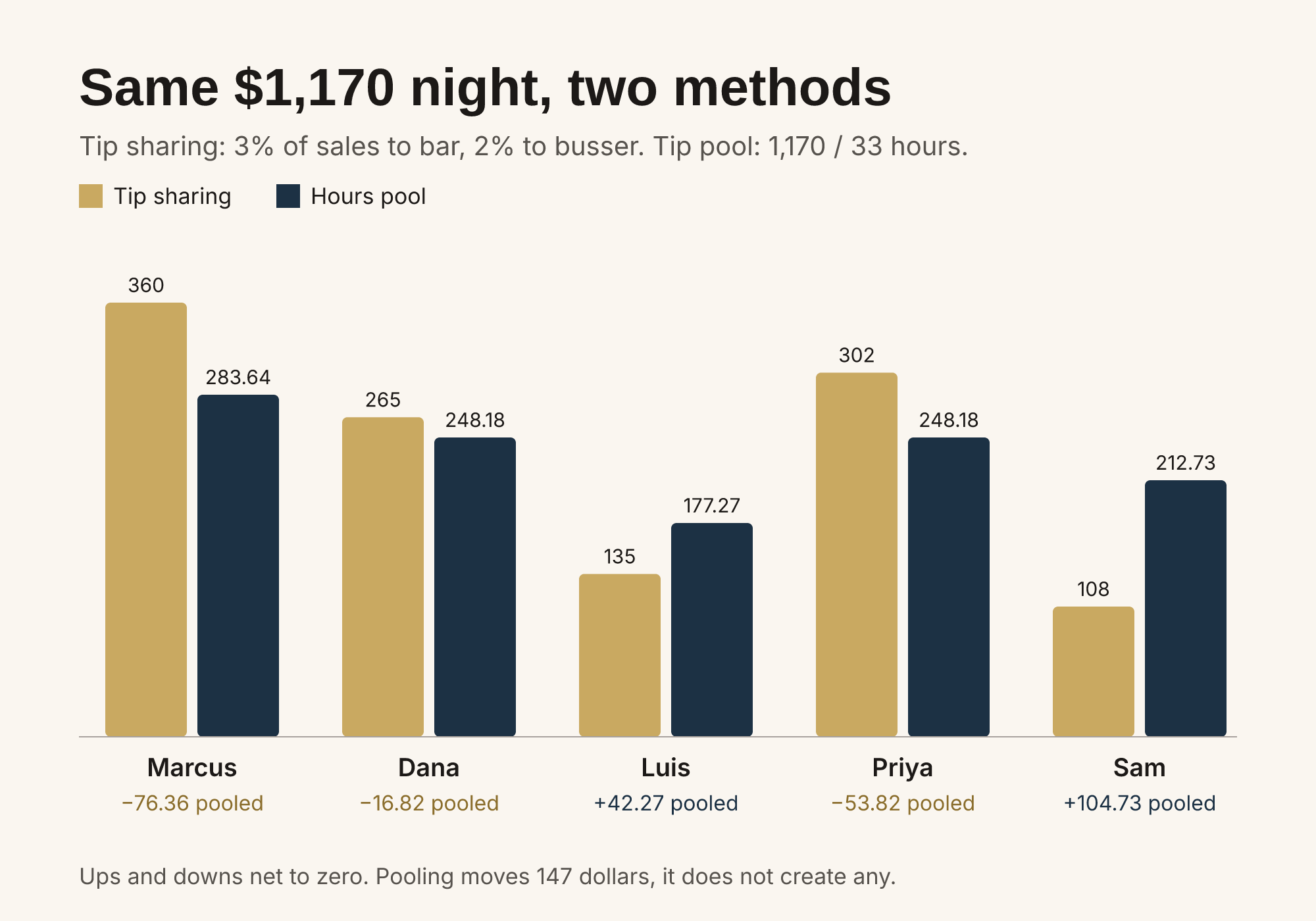 Same 1,170 dollar Friday, two methods. Sharing keeps the peaks; pooling flattens them.
- Marcus: 360 shared vs 283.64 pooled. Down 76.36.
- Dana: 265 vs 248.18. Down 16.82.
- Luis: 135 vs 177.27. Up 42.27.
- Priya: 302 vs 248.18. Down 53.82.
- Sam: 108 vs 212.73. Up 104.73.
The ups and downs net to zero. Pooling did not create money. It moved 147 dollars from the strong sections and the bar to the light section and the busser.
That is the trade in one line: sharing rewards the individual night, pooling protects the team's average. Which one is "fair" depends on how your service runs, not on the math.
Which one fits your floor
Lean toward tip sharing when:
- Servers own defined sections and work them for their own tables
- Sections are roughly even, so a big night is mostly effort
- Support staff is small and your servers reliably tip them out
Lean toward tip pooling when:
- Anyone on the floor might touch any table, so a section is a team effort
- Section quality is uneven and luck of the seating chart is causing fights
- You want support roles to have a take-home they can plan around
Plenty of operators run a hybrid: pool the servers by hours, then tip out the bar a percentage on top. That is fine as long as the total out matches the total in.
One caveat that sits above all of this math: who is allowed in a tip pool and how tipped wages work are set by federal and state law, change over time, and are contested in places right now. Before you lock in a policy, confirm the current rules for your state with your labor counsel or state labor agency.
What usually goes wrong at close
The math is rarely the problem. These are.
Cash stays out of the pool. Card tips go in, cash goes in pockets. Your pool is now short and nobody wrote it down. Fix: card and cash both get entered before anyone clocks out.
The tip-out gets paid from memory. Under sharing, a server at 11:40 at night "rounds" the busser's cut. Do that across three servers and Sam is short 15 dollars he will never be able to prove. Fix: the tip-out percentage gets written next to each server's sales on the sheet, not figured in their head.
The formula changes after a big night. Someone pushes for role weights on the Saturday Marcus had a monster section. Changing the rule mid-week is the fastest way to lose the room. Fix: change the method on a set date, announce it a week ahead, and run it the same way every shift after that.
Nobody keeps the record. Two weeks later someone asks what they made on the 14th and there is no sheet. Fix: one saved record per shift, every shift.
Copy-paste: the tip policy block
Drop this into your shift-lead binder and fill in the blanks:
TIP HANDLING POLICY (effective ___/___)

Method: [ ] Tip pool   [ ] Tip sharing (tip-out)   [ ] Hybrid

IF POOL:
- All tips, card AND cash, go into one pool before clock-out.
- Split by: [ ] hours only  [ ] hours x role weight
- Role weights: Server ___ | Bartender ___ | Busser ___ | Runner ___
- Rounding: leftover cents go to the longest shift.

IF TIP SHARING:
- Servers keep their own tips.
- Bar tip-out: ___% of [sales / tips]
- Support tip-out: ___% of [sales / tips]
- Written on the shift sheet next to each server's sales.

EVERY SHIFT:
- Total paid out = total collected. Closer signs the sheet.
- Record saved and kept for: ___ (confirm with your labor counsel)
- Method only changes on a posted date, never mid-week.
Stop running the pool on a napkin
Whichever way you go, somebody is doing division at close while the crew waits, and that is where the shorted-by-twelve-dollars texts come from.
The Tip Pool Calculator settles the pool side in about 3 taps. Enter the night's card and cash tips, add who worked with their role and hours, and it returns every payout. Hours-weighted or a flat split by role, your call. Every shift saves to history, and you can export it to CSV when payroll or an owner asks for it.
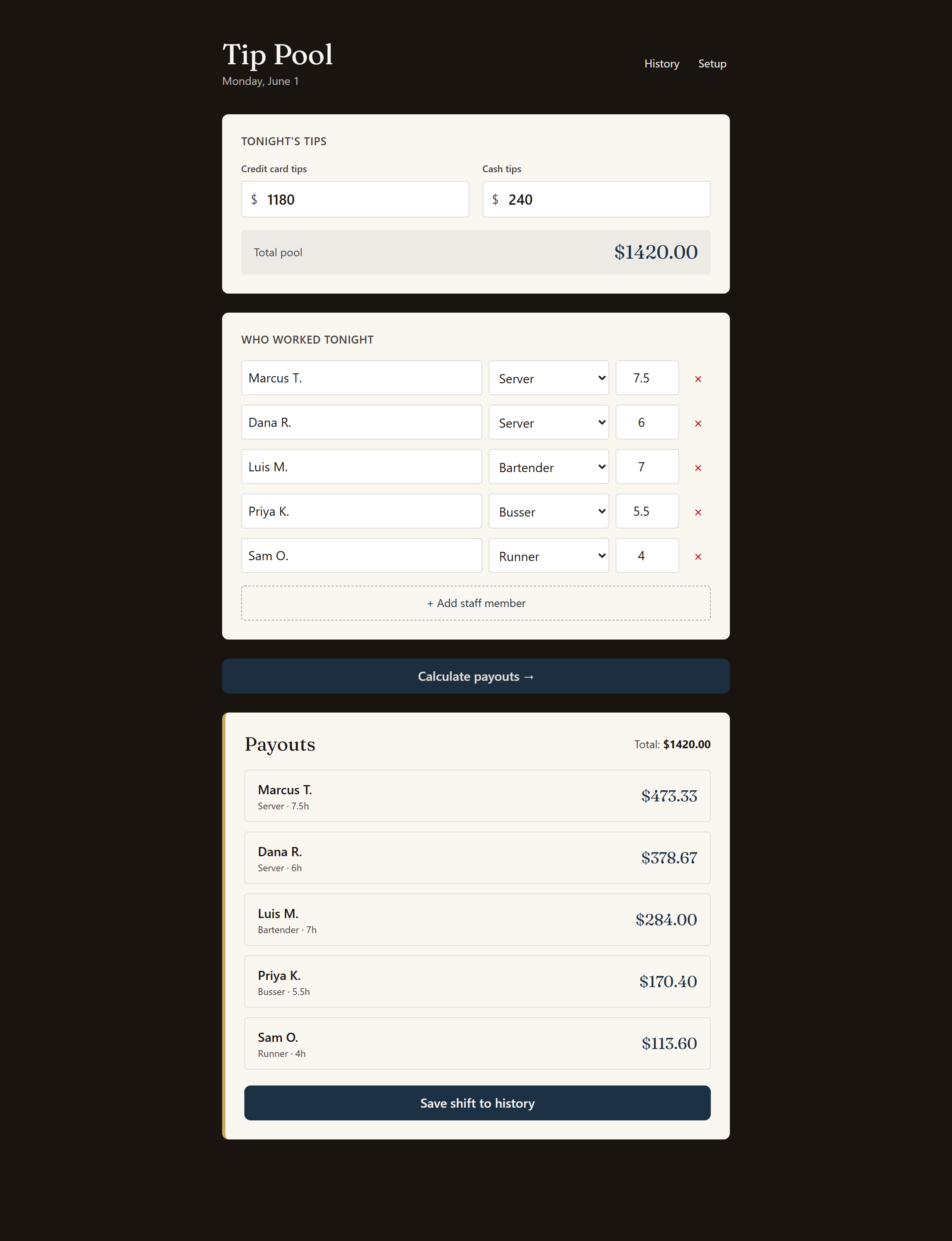 A 1,420 dollar pool entered, split, and ready to save to history
It is $9 a month with a 14-day free trial, and it is part of the WRI Starter suite. You pick the fairness rule. It does the arithmetic and keeps the record.
Frequently asked questions
What is the difference between tip pooling and tip sharing?
Tip pooling puts every tip from the shift into one pot and divides the whole pot back out by a formula, usually hours worked or hours times a role weight. Tip sharing lets each server keep their own tips and pay a set percentage to support staff. Pooling divides a total down; sharing takes a slice off each person's own earnings.
Which pays servers more, tip pooling or tip sharing?
On a strong night, tip sharing usually pays the top server more because they keep most of what their own section earned. Tip pooling averages that night across everyone, so strong sections take home less and slower sections and support staff take home more. Neither method creates more money; they only change who carries the swing.
Is tip sharing the same as a tip-out?
Yes. Tip sharing is what most restaurants call a tip-out. Each server figures a percentage of their sales or their tips, pays it to the bar, bussers, or runners at the end of the shift, and keeps the rest.
How do you calculate a tip pool split by hours?
Add up every tip from the shift, card and cash, into one total. Add up the hours everyone in the pool worked. Divide the total by the hours to get a per-hour rate, then multiply each person's hours by that rate. The payouts should add back up to the pool total.
Can I run a hybrid of tip pooling and tip sharing?
Many restaurants do. A common setup pools the servers by hours, then has the pool tip out the bar or support staff a set percentage on top. The math is the two methods stacked, and the total paid out still has to equal the total collected. Who is allowed in a pool is set by federal and state law, so confirm your state's current rules with your labor counsel first.