How Much Does a No Call No Show Cost a Restaurant? The Math
How much does a no call no show cost a restaurant? Price one missed Friday shift line by line, then log call-offs so the pattern shows before it repeats.
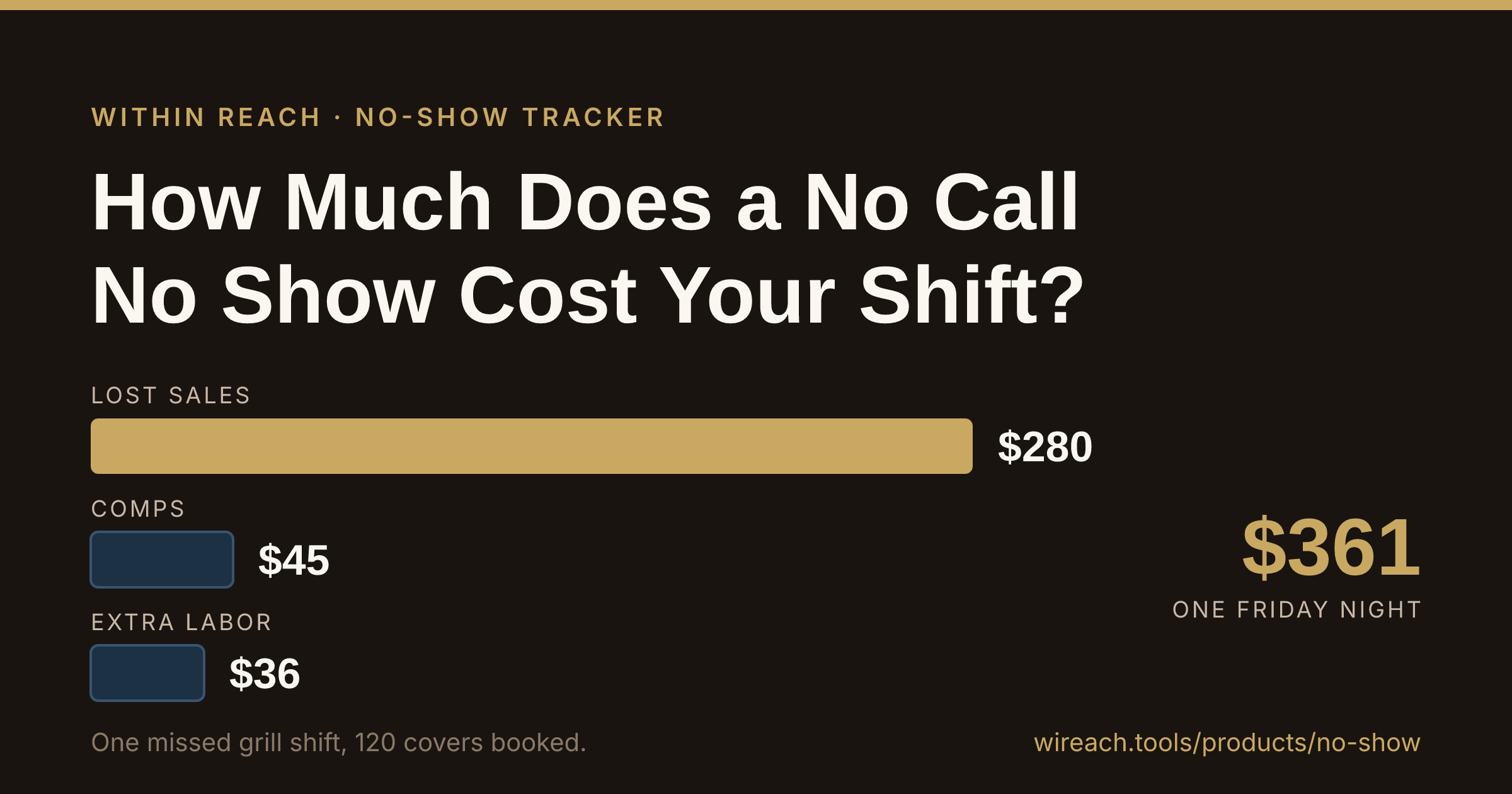
It is 4:45 on a Friday, the grill cook is not here, and he is not answering his phone. You already know how the night is going to go. What most managers never do is put a number on it the next morning.
If you have ever asked how much does a no call no show cost a restaurant, the honest answer is more than the hourly wage you did not pay. The wage is the one cost that goes away. Everything else shows up somewhere else on the P&L, and it shows up again every time the same person does it.
This walks through one missed shift line by line, shows where the costs hide, and gives you a log and a threshold so the second one gets caught before the fifth.
Price one missed shift, line by line
Take a real night. Ours is a Friday dinner with 120 covers on the books and a $28 average check. The scheduled grill cook, a 6-hour shift at $18 an hour, is a no call no show.
Here is what the night actually lost.
- Lost sales. With one cook short, tickets ran long and the host slowed seating. We turned 10 fewer covers than booked. 10 covers at $28 is $280 in sales that walked out or never sat down.
- Comps. Three tables waited long enough that the manager comped desserts and a round of drinks. That came to $45.
- Extra labor. The replacement cook came in 90 minutes late, so a prep cook stayed 2 extra hours to hold the station. 2 hours at $18 is $36. To see what a week of extra hours does to your labor percent, run it through the restaurant labor cost calculator.
That is $361 for one night. The $108 you did not pay the missing cook mostly went to the replacement who came in late, and it does not cancel any of this. You still lost the sales and paid the comps and the extra hours.
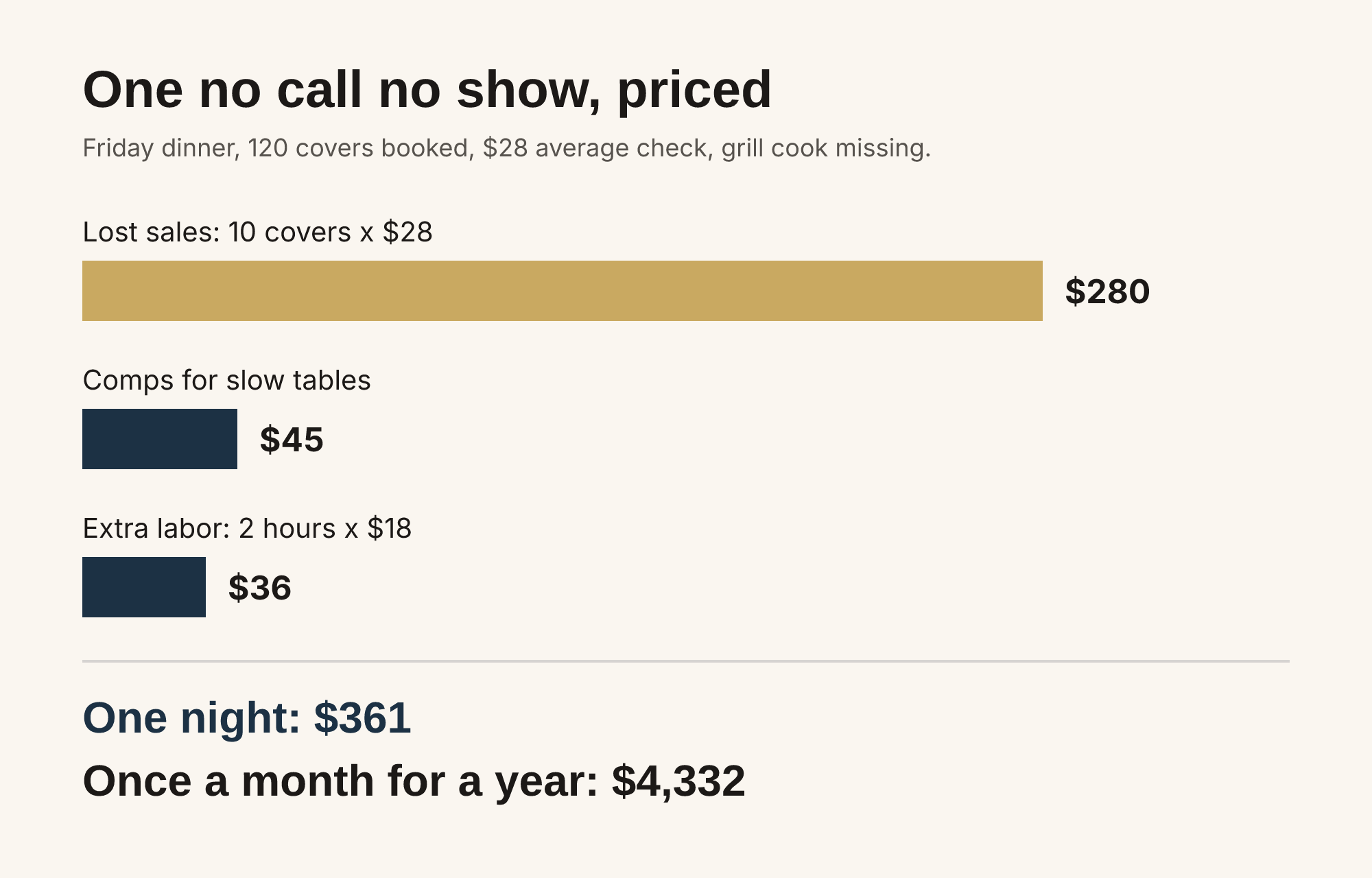 One no call no show on a 120-cover Friday. Lost sales are most of it.
Now the part people skip. If that same cook does it once a month, that is 12 nights. 12 times $361 is $4,332 a year from one person, and that is before you count the manager's 45 minutes on the phone or the server who quits after the third bad Friday.
Find the costs that do not show up on the schedule
The three numbers above are the ones you can pull from the POS and the time clock. A few more are real, they are just harder to price:
- Manager time. Every no-show pulls a manager off the floor to make calls, jump on the line, or reshuffle stations. That is the person who should be watching ticket times.
- The rest of the crew. The people who showed up worked harder for the same pay. Do that to them every other weekend and they start looking at the place down the street.
- Guest memory. The table that waited 40 minutes for a burger does not know a cook ghosted you. They know your kitchen was slow.
You do not need to price these perfectly. You need to know they are there, so you stop treating a no-show as "we got through it."
If you want to run your own numbers, use the free cost of a no-show calculator. Plug in the hours left uncovered, the straight-time rate of whoever covers, an overtime multiplier (1 if the cover stays at straight time), your estimated lost sales, and how many no-shows you get a month. It gives you the cost of one no-show and the cost per month. There is no separate comps line, so fold comps into your lost sales number. Our Friday goes in as 2 hours at $18, a multiplier of 1, and $325 in lost sales and comps, which comes back to $361.
Log every call-off the night it happens
Here is where most places lose the thread. The no-show happens, the manager covers it, and nobody writes it down. Two weeks later a different manager covers the same person's missed Tuesday. Nobody has the full picture, so nothing happens.
Log every call-off and every no call no show the same night. You need five fields:
- Date and shift
- Employee and role
- Call-off or no call no show
- How much notice you got
- Who covered and how
A notebook in the office works if every manager actually uses it. Most of the time they do not, which is why we built a no-show tracker that logs call-offs in 4 taps. When logging takes less time than complaining about it, the log stays complete.
Set a threshold and apply it to everyone
A log without a line in the sand is just a diary. Decide ahead of time what triggers a conversation, write it down, and use the same rule for your best server and your newest dishwasher.
A simple starting point:
- 1 no call no show: a same-week conversation. What happened, and what should they do next time.
- 2 no call no shows, or 3 call-offs, in 30 days: a written sit-down with a manager.
- Past that: whatever your written policy says, applied the same way it was applied last time.
The point is consistency. When the crew sees the rule hit the strong cook the same way it hits the new hire, the rule starts to mean something. Attendance and discipline rules vary by state and by your own handbook, so run the written version past whoever handles HR for you before you post it.
Give people a way out that is not ghosting
Most no-shows are not people who planned to blow you off. They are people who had something come up, felt bad about calling, and then felt worse about calling late. So they did not call.
Cut that off with three things:
- A call-off deadline. "Call the manager on duty at least 4 hours before your shift." Posted, said out loud at pre-shift, same for everyone.
- A real swap process. If someone can hand a shift to a teammate, they do not need to vanish. A shift swap board where a teammate can claim the open shift does that without anyone handing out their personal number.
- A follow-up every single time. Not a lecture. A two-minute conversation the next shift. People stop ghosting when they know someone will ask.
Copy-paste call-off log and attendance policy lines
Print this log and keep it at the manager station.
CALL-OFF / NO-SHOW LOG
Date | Shift | Employee | Role | Type (CO / NCNS) | Notice given | Covered by | Cost notes
_____|_______|__________|______|__________________|______________|____________|___________
_____|_______|__________|______|__________________|______________|____________|___________
_____|_______|__________|______|__________________|______________|____________|___________
Weekly review: anyone at 2+ entries in 30 days? ____________
And policy lines you can adapt for your handbook:
If you cannot work a scheduled shift, call the manager on duty at least 4 hours before it starts. A text alone does not count as a call-off. Not calling and not showing up for a scheduled shift is a no call no show. Two no call no shows, or three call-offs, in 30 days will lead to a written sit-down with a manager. Shift swaps are allowed once a manager approves them.
What usually goes wrong
The most common failure we see is the manager who quietly covers it. The cook does not show, the manager jumps on the grill, the night survives, and it never gets logged. The manager feels like a hero. The pattern stays invisible, and the next manager covers it again.
The second one is the uneven rule. The best cook in the building misses two Saturdays and gets a pass, while the new dishwasher gets written up for one. The crew notices in about a day, and your threshold stops meaning anything.
Log it every time, including when you covered it yourself. Apply the rule the same way every time. That is the whole fix.
Catch the pattern before it costs you
The math is simple. One no call no show on a busy night costs real money, and the same person doing it again costs it again. The hard part is seeing the pattern while it is still small. No-Show Tracker lets your managers log a call-off in 4 taps and sends a pattern alert when an employee crosses the threshold you set, so the second no-show gets a conversation instead of a shrug. It is $14 a month with a 14-day free trial, and it is part of the WRI Standard suite.
 No-Show Tracker, part of the WRI Standard suite.
Frequently asked questions
How much does a no call no show cost a restaurant?
Add up what the shift lost: sales from covers you could not seat or turn, comps for slow tickets, and extra labor paid to people who stayed late to cover. For example, one line cook missing a 120-cover Friday dinner cost about $361 in one night, before counting the manager's time on the phone.
What counts as a no call no show versus a call-off?
A call-off is when the employee tells you before the shift that they are not coming. A no call no show is when they never contact you and simply do not arrive. Both cost money, but a no call no show costs more because you find out at the start of the shift with no time to cover it.
How do I track staff no-shows in a restaurant?
Log every call-off and no-show the same night with the date, the shift, the role, and how much notice you got. Keep it in one place every manager uses, then review it weekly for anyone who keeps showing up in the log.
How many no-shows before I act?
Pick a threshold, write it down, and apply it to everyone the same way, for example 2 no call no shows or 3 call-offs in 30 days triggers a sit-down. Run the written policy past whoever handles HR for you before you post it, since rules vary by state.
How do I reduce no-shows without hiring more people?
Give people a legit way out. A visible shift swap process, a clear call-off deadline, and a manager who follows up every single time cut more no-shows than threats do. People ghost when calling in feels worse than not showing up.