How to Calculate Labor Cost Percentage for a Restaurant
How to calculate labor cost percentage for a restaurant: labor dollars divided by sales, times 100. Worked $18,500 week, SPLH, and a daily sheet to copy.
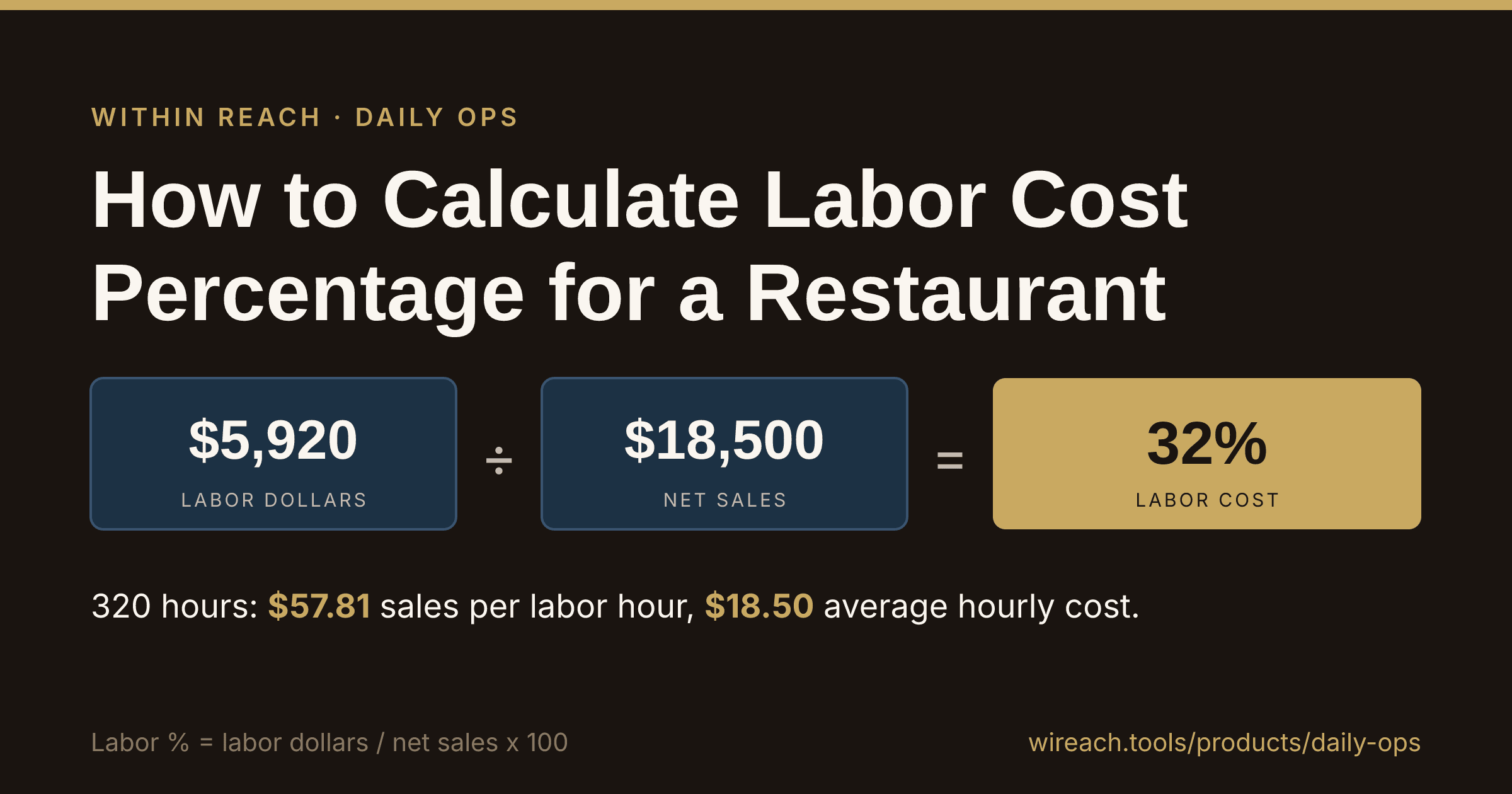
You find out labor ran high when the week is already over. The schedule looked right on Sunday, nobody called it in, and the number still came back three points heavy.
Labor cost percentage is the fastest way to see that coming. It is one division problem. This walks through how to calculate labor cost percentage for a restaurant, one full week carried from start to finish, the two other numbers that come out of the same three inputs, and a daily sheet you can copy before your next shift.
The labor cost percentage formula
You need three numbers, all from the same period. Same shift, same day, or same week. Never mix them.
- Labor percent = labor dollars / net sales x 100
- Sales per labor hour (SPLH) = net sales / labor hours
- Average hourly cost = labor dollars / labor hours
Net sales is what the POS shows after comps and discounts, before tax and tips. Labor dollars is wages for the period, overtime included. Labor hours is total clocked time from your time clock or POS.
If you would rather not do the division by hand, plug your three numbers into the free labor cost calculator. It gives you labor percent, SPLH, and average hourly cost as you type.
A worked week: $18,500 in sales
Here is one week carried all the way through. These are the same numbers the calculator loads with, so you can check every line against it.
| Input | Amount |
|---|---|
| Net sales | $18,500 |
| Labor dollars | $5,920 |
| Labor hours | 320 |
Step by step:
- Labor percent: 5,920 / 18,500 = 0.32, times 100 = 32%
- Sales per labor hour: 18,500 / 320 = $57.81
- Average hourly cost: 5,920 / 320 = $18.50
So 32 cents of every sales dollar went to the people on the clock. Every hour somebody was punched in brought in $57.81 in sales and cost you $18.50.
That $18.50 is not anybody's pay rate. It is the blended cost of one hour on your floor, cooks, cashiers, and overtime all mixed together. If it creeps up and nobody got a raise, overtime is the first place to look.
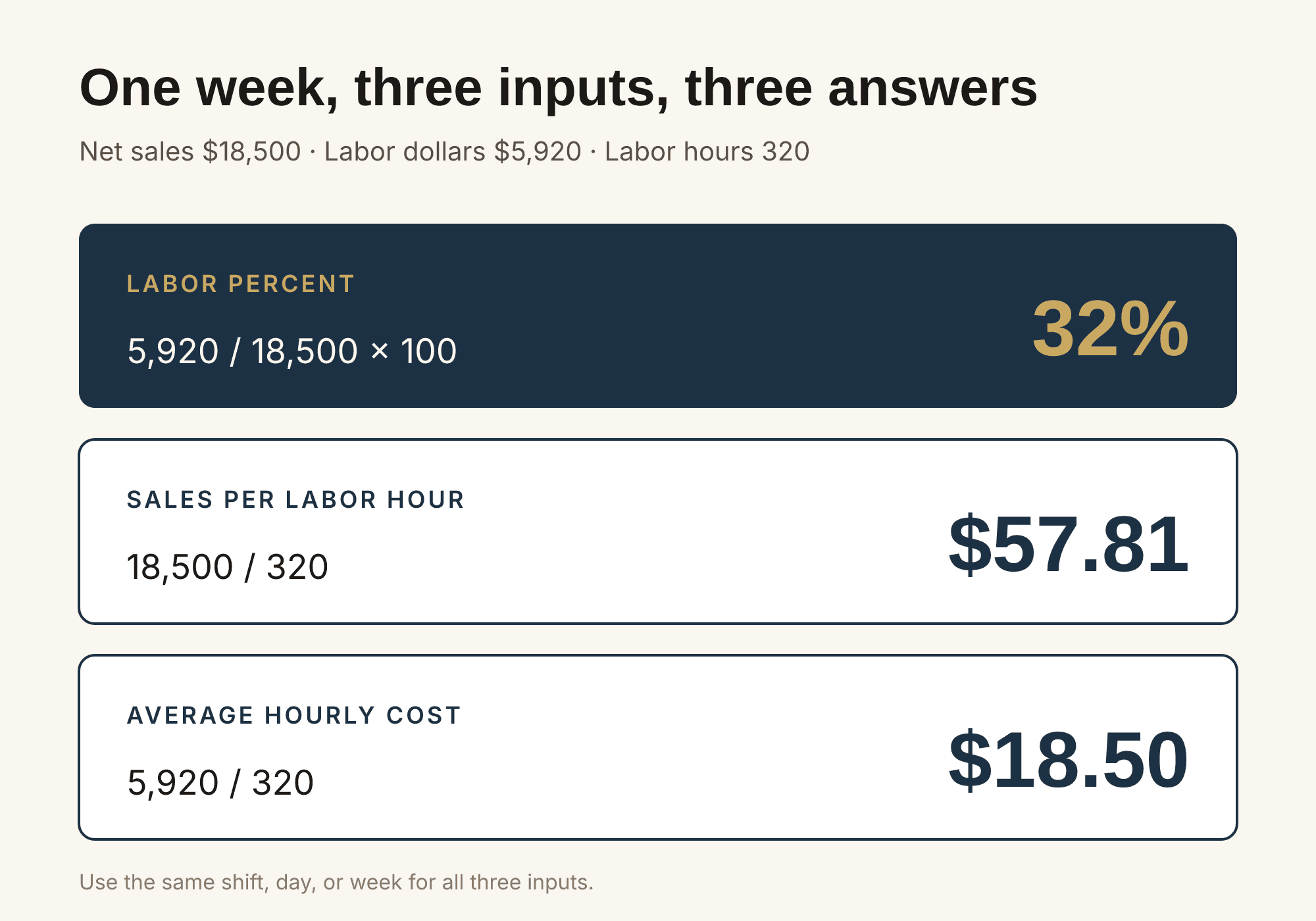 Three inputs, three answers. Use the same period for all of them.
The math is easy. Getting the numbers every day is the hard part. A shift report that logs every close and emails you the summary means each night's close is already waiting in your inbox when you sit down to run the numbers, instead of buried in three managers' heads.
Get the inputs right or the number lies
Most bad labor percentages are not math mistakes. Something got counted wrong.
- Gross sales instead of net. Comps and discounts come off first. Gross sales make labor look better than it is.
- Scheduled hours instead of clocked hours. The schedule says 320. The time clock might say 341 because closers stayed late. Use what got punched.
- Forgetting overtime. Overtime dollars are labor dollars. Leave them out and the week that went sideways looks normal.
- Mixing salaried and hourly one week but not the next. Many operators track hourly labor on its own, then a fully loaded number with salaries, payroll taxes, and benefits. Either is fine. Switching between them is not.
- Mismatched periods. Sales through Sunday and labor through Saturday will give you a number, and it will be wrong.
If you want the fully loaded version with food in the same view, that is prime cost. The weekly prime cost walkthrough carries a full week of food and total labor through the same way.
Labor percent vs sales per labor hour
Labor percent and SPLH come from the same inputs but answer different questions.
Labor percent answers: how much of my sales is going to payroll? It moves when sales move and when wages move. Give the crew a raise and labor percent goes up even if you ran the exact same schedule.
SPLH answers: how much is each hour on the clock bringing in? It ignores pay rates entirely. That makes it the better number for writing a schedule. If your Tuesday lunch does $1,200 and you know you need about $57 per labor hour to hit your target, that shift supports roughly 21 hours of labor across everybody on it.
Use labor percent to judge the week. Use SPLH to build the next one. If you want to work the schedule side, the sales per labor hour calculator shows how many hours your projected sales can carry.
What usually goes wrong
The classic mistake is managing to the percentage instead of the shift. Labor reads high at 2 p.m., so the manager sends two people home. The rush comes at 5:30, the line falls behind, the closers get buried, close runs an hour long, and now there is overtime on the back end that eats the savings plus some.
The other one is waiting. If the only time you look at labor is the weekly report, the week is gone before you see it. A slow Monday and Tuesday staffed like a normal week will push the whole week high, and by Friday there is not enough schedule left to pull it back.
The fix for both is the same. Check it daily, check it mid-shift on busy days, and decide with the floor in front of you, not just the number.
This is how I look at it as a GM:
I don't manage labor by staring at a percentage and sending people home.
I watch sales, who's on the clock, what business actually looks like, and what's still left to get done. Sometimes cutting one person saves labor. Sometimes it means the people who stay get buried, closing takes longer, overtime shows up later, and the guest pays for it.
I also don't wait until the end of the week to find out labor was bad. By then, there's nothing left to manage.
The calculator gives me the percentage. My job as the GM is deciding what to do with it.
Good labor management isn't about running the fewest people possible. It's about having the right people, in the right place, at the right time, and knowing when the business changes enough to adjust.
For reference, my store aims for 21.47% labor and 30% food cost, with 36% as the ceiling. Your numbers will look different depending on your concept. What matters is knowing yours every day.
A commonly cited range for hourly labor is about 25% to 35% of sales. Scratch kitchens and full service run higher, counter service runs lower. Do not chase somebody else's target. Know yours and watch which way it is moving.
A daily labor sheet you can copy
Fill one row at close every day. Keep the week on one page so you can see it drifting before Sunday.
| Day | Net sales | Labor $ | Labor hours | Labor % | SPLH | Avg hourly | Note |
|---|---|---|---|---|---|---|---|
| Example week | $18,500 | $5,920 | 320 | 32% | $57.81 | $18.50 | |
| Mon | |||||||
| Tue | |||||||
| Wed | |||||||
| Thu | |||||||
| Fri | |||||||
| Sat | |||||||
| Sun | |||||||
| Week total |
How to fill it:
- Net sales from the POS at close, after comps and discounts.
- Labor dollars and hours from the time clock for the same day, overtime included.
- Do the math, or check the day in the labor cost calculator before you write it down.
- Write one line in the note column any day labor moves more than two points: who stayed late, what got cut, what the sales did.
- Total the week from the daily rows, not from a separate report, so the two always agree.
Keep the shift record that explains the number
The percentage tells you labor moved. It does not tell you why. The why lives in what happened on each shift: the closer who stayed two hours over, the cook who called off, the Tuesday that did half its normal sales.
Daily Ops is the shift report that runs itself: opening, closing, and mid-shift checklists with temp and cash logging, and an auto-summary email at close. Every close sends a summary to your inbox, so when labor jumps you have a record of each shift to check it against. It is $19 a month with a 14-day free trial, so you can run it for two weeks and see whether your labor conversations get shorter.
Frequently asked questions
How do you calculate labor cost percentage for a restaurant?
Divide labor dollars by net sales for the same period and multiply by 100. A week with $5,920 in labor on $18,500 in sales is 5,920 / 18,500 = 32%.
What counts as labor dollars?
Hourly wages for the period, including overtime. Salaried managers, payroll taxes, and benefits can be tracked separately or folded in, but pick one way and use it every time so the weeks compare.
What is sales per labor hour?
Net sales divided by the hours your crew clocked in the same period. $18,500 in sales over 320 hours is $57.81 per labor hour. It does not move when you give raises, which makes it a clean number to schedule by.
What is a good labor cost percentage for a restaurant?
A commonly cited range for hourly labor is about 25% to 35% of sales, depending on the concept and how much is made from scratch. Your own week over week trend tells you more than any industry number.
Why did labor percent go up when the schedule stayed the same?
Sales dropped. Labor percent is labor divided by sales, so the same hours on a slower week cost a bigger share. That is why you check it during the week instead of after it closes.