How to Calculate Prime Cost for a Small Restaurant Weekly
How to calculate prime cost weekly: add food and beverage cost to total labor, divide by sales. Worked $42,000 week example and a weekly sheet to copy.
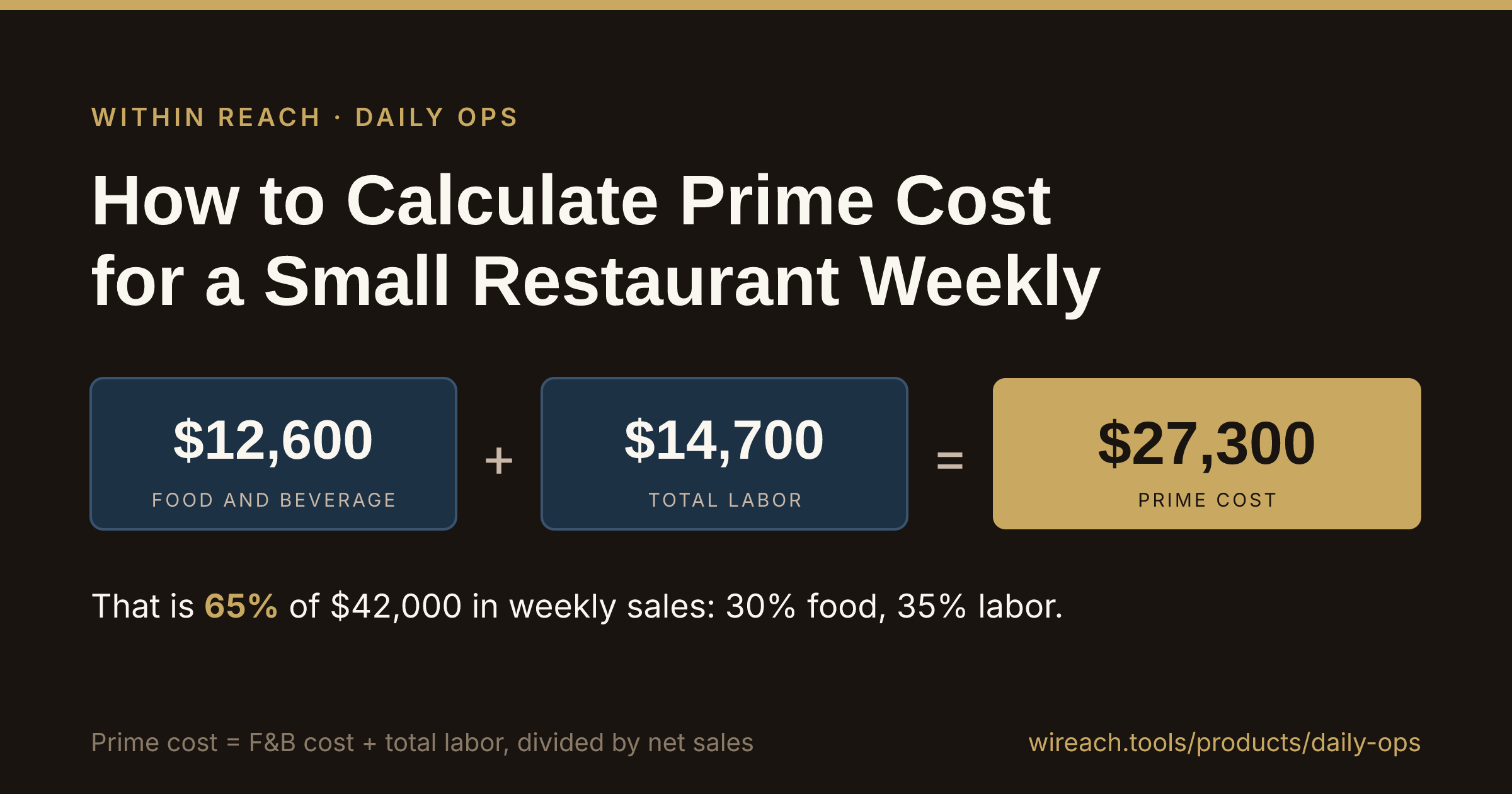
Food cost looked fine last month. Labor looked fine too. And somehow the P&L still came back thin. That usually means you were looking at the two biggest costs in the building one at a time, a month late.
Prime cost puts them together. It is your food and beverage cost plus every labor dollar, as a percent of sales. This walks through how to calculate prime cost weekly, one full week carried from start to finish, what to check when the number moves, and a sheet you can copy for Monday morning.
The prime cost formula
Three lines, and the order matters:
- Total labor = hourly wages + salaried pay + payroll taxes and benefits
- Prime cost = food and beverage cost + total labor
- Prime cost percent = prime cost / net sales x 100
Food and beverage cost is your cost of goods sold for the week: beginning inventory, plus purchases, minus ending inventory. That covers food, beer, wine, and liquor. Net sales is after comps and discounts, before tax and tips.
If you want the division done for you, run your week in the free prime cost calculator. You enter five numbers and it gives you prime cost in dollars, prime cost percent, and the food and labor split.
A worked week: $42,000 in sales
Here is one week carried all the way through. These are the same numbers the calculator loads with, so you can check every line.
| Line | Amount |
|---|---|
| Net sales | $42,000 |
| Food and beverage cost | $12,600 |
| Hourly wages | $9,500 |
| Salaried pay | $2,800 |
| Payroll taxes and benefits | $2,400 |
Step by step:
- Total labor: 9,500 + 2,800 + 2,400 = $14,700
- Prime cost: 12,600 + 14,700 = $27,300
- Prime cost percent: 27,300 / 42,000 = 65%
- The split: food and beverage is 12,600 / 42,000 = 30%, labor is 14,700 / 42,000 = 35%
So 65 cents of every sales dollar went to food and the people who cooked and served it. Everything else, rent, utilities, repairs, and whatever is left for you, comes out of the other 35 cents.
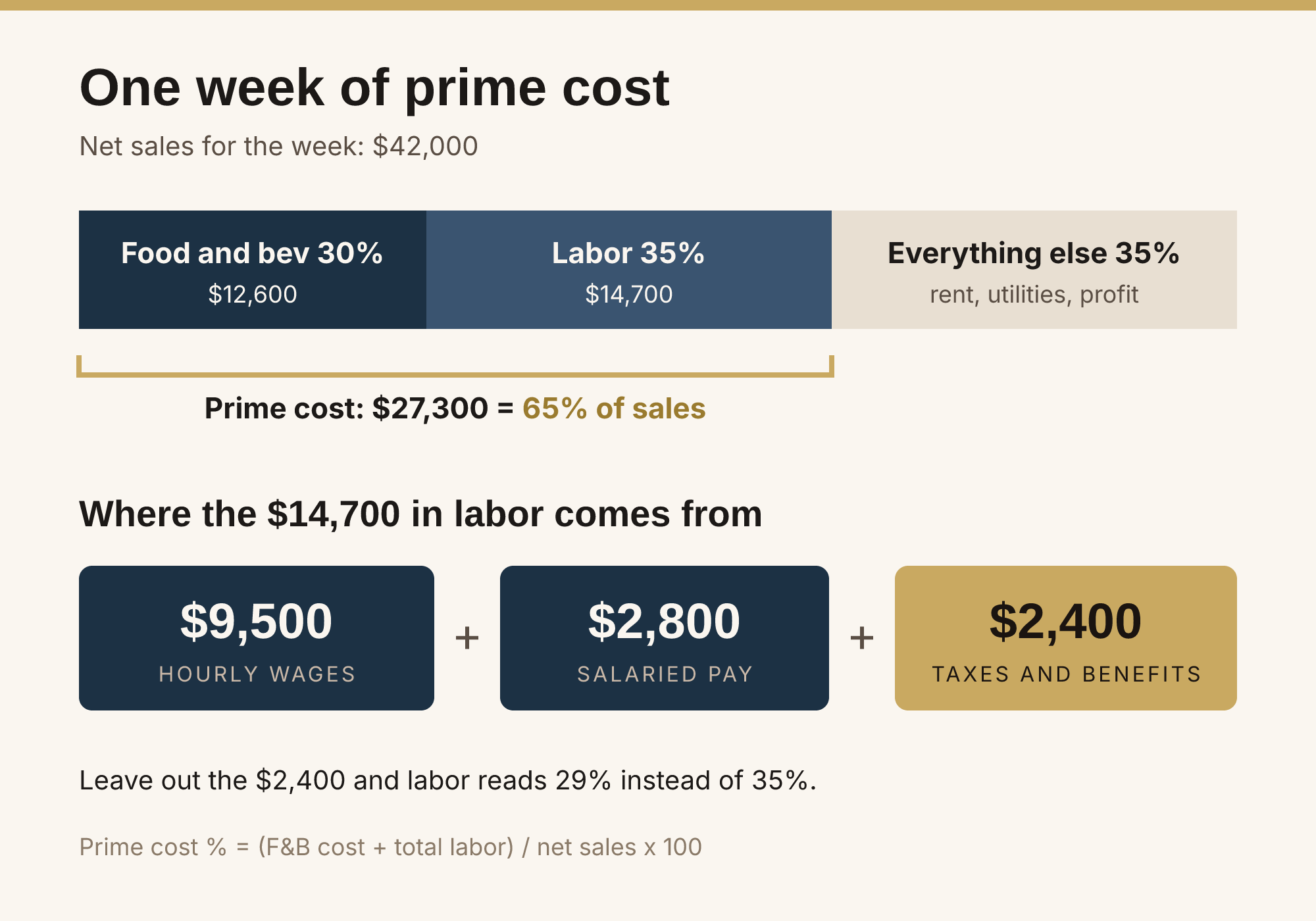 One week, five numbers. The split tells you which side to look at when the total moves.
The math only works if somebody pulls the numbers on time every week. A shift report that logs each close and emails you the summary means the cash counts and the notes from every shift are already waiting for you on Monday instead of scattered across three managers.
Get the inputs right or the number lies
Most bad prime cost numbers are not math mistakes. Something got left out.
- Leaving out taxes and benefits. In the example, that $2,400 is almost 6 points of sales. Drop it and labor reads 29% instead of 35%, and you think you have room you do not have.
- Leaving out salaried managers. Prime cost is all labor, not just hourly. Use one week of salary for every manager and chef on this store's payroll.
- Using purchases instead of a real count. If you buy heavy this week and light next week, purchases alone swing your food cost all over the place. You need an actual inventory count each week for the cost of goods to mean anything.
- Mixing gross and net sales. Comps and discounts come off first. Using gross sales makes every percent look better than it is.
If your food side keeps coming in higher than your recipes say it should, the food cost variance calculator compares what you should have used against what you actually used.
Weekly beats monthly
A month is too long to find out overtime ran wild in week one or a vendor raised the case price on your top protein. By the time the monthly P&L shows it, the money is gone.
Weekly gives you three or four chances a month to catch it. Pick one day, pull the same five numbers the same way, and write the result down next to last week. The trend is what you are watching.
A commonly cited range for prime cost is about 55% to 65% of sales. Full service with a big bar program can look different from quick service. Do not chase somebody else's target. Chase your own number going the right direction.
What usually goes wrong when it moves
The number tells you something changed. It does not tell you what. When prime cost climbs, split it back into food and labor and see which side moved.
If labor moved:
- Overtime. One closer picking up extra shifts can push a week over before anybody notices.
- The schedule did not follow sales. A slow Tuesday staffed like a Friday.
- A new hire training on the clock alongside a full crew.
If food and beverage moved:
- Portions creeping heavy on the line. If that is the problem, cost the plate the way the line actually builds it.
- Waste and spoilage that never got logged.
- Comps going out without a reason written down.
- A vendor price that went up and nobody re-costed.
The trap is reacting to the total. Prime cost goes up two points, somebody cuts the schedule, labor drops, and now service slips and the food side keeps climbing because the real problem was waste.
This is how I look at it as a GM:
I watch prime cost because it tells me pretty quickly whether the restaurant is actually under control.
Food cost can look good while labor is running high. Labor can look great because we cut too hard, while waste, comps, and poor execution are eating up the savings somewhere else. Looking at one number by itself doesn't tell the whole story.
Prime cost puts the two biggest controllable expenses in front of me at the same time.
When that number starts moving the wrong way, I don't just tell the team to cut costs. I want to know why. Is it overtime? Over-portioning? Waste? Scheduling? Vendor prices?
The calculator tells me where we are. My job as the GM is figuring out what's driving the number and what we can actually fix.
A weekly prime cost sheet you can copy
Same day every week. Fill one row per week and keep them on one page so you can see the trend.
| Week of | Net sales | F&B cost | Hourly | Salaried | Taxes and benefits | Total labor | Prime cost | Prime % | Food % | Labor % |
|---|---|---|---|---|---|---|---|---|---|---|
| Example | $42,000 | $12,600 | $9,500 | $2,800 | $2,400 | $14,700 | $27,300 | 65% | 30% | 35% |
How to fill it:
- Sales: net sales from the POS for the week, after comps and discounts.
- F&B cost: beginning inventory plus purchases minus ending inventory. Count on the same day every week.
- Labor: every hourly dollar including overtime, one week of salary, and one week of employer taxes and benefits.
- Do the math or check the week against the prime cost calculator before you file it.
- Write one line next to any week that moved more than a point: what changed and what you are doing about it.
Keep the week from surprising you
The weekly number is only as good as what happened on each shift. If the closers are not writing down the overtime call, the walk-in that ran warm, or the 86 that turned into a comp, you are guessing on Monday about why the number moved.
Daily Ops is the shift report that runs itself: opening, closing, and mid-shift checklists with temp and cash logging, and an auto-summary email at close. Every shift lands in your inbox, so when prime cost jumps you already have the notes to explain it. It is $19 a month with a 14-day free trial, so you can run it for two weeks and see whether Monday gets easier.
Frequently asked questions
How do you calculate prime cost for a restaurant?
Add your food and beverage cost of goods sold to your total labor for the same period. Total labor means hourly wages, salaried pay, and payroll taxes and benefits. Divide that sum by net sales and multiply by 100 to get prime cost percent.
What is a good prime cost percentage?
A commonly cited range is about 55% to 65% of sales. Full service with a big bar program can look different from quick service, so your own week over week trend matters more than any one target.
Why calculate prime cost weekly instead of monthly?
A month is too long to find out overtime ran wild or a vendor raised prices. A weekly number gives you three or four chances to fix a problem before the month closes.
Do payroll taxes and benefits count in prime cost?
Yes. Employer payroll taxes, health insurance, workers comp, and other benefits are labor. Leave them out and your labor looks a few points better than it really is.
What do I check first when prime cost goes up?
Split it back into food and labor and see which side moved. If labor moved, look at overtime and the schedule against sales. If food moved, look at portions, waste, comps, and vendor prices.