How to Calculate Par Levels for a Restaurant: The Formula
How to calculate par levels for a restaurant: the par formula, a worked chicken example, how to set safety stock, and a par sheet you can copy tonight.
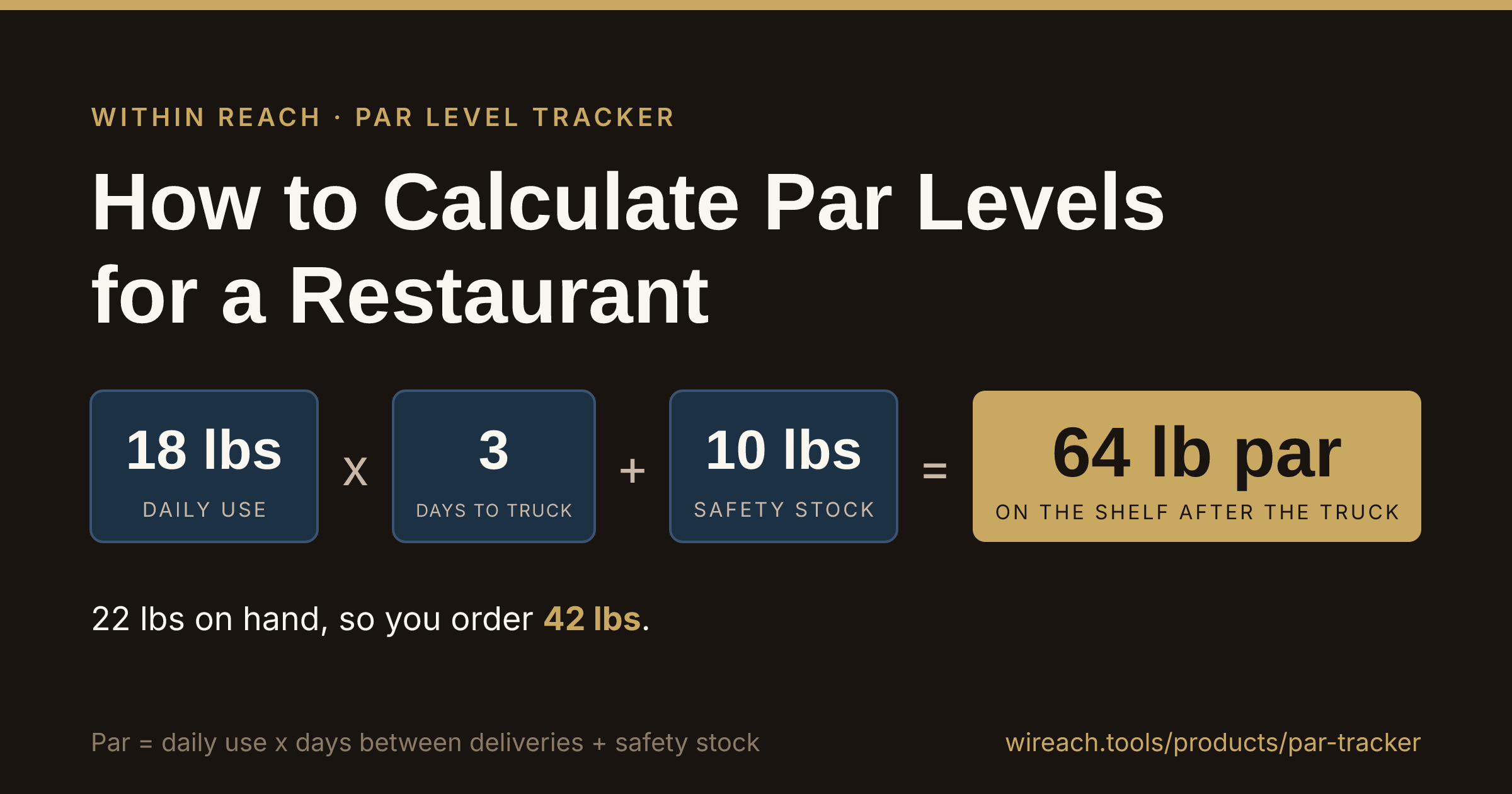
You ran out of chicken at 7:10 on a Friday, and on Monday you threw out a case of romaine that never got touched. Same walk-in, same week, same "we just order what feels right." That is what happens when par lives in somebody's head instead of on paper.
Learning how to calculate par levels for a restaurant takes about ten minutes per item, and the math is one line. This walks through the formula, one worked example from start to finish, how to pick safety stock without guessing, and a par sheet you can copy and use on tonight's count.
The par level formula in one line
Par is the amount of an item you want on the shelf right after a delivery, so you make it to the next truck without running out. The formula:
Par = average daily use x days between deliveries + safety stock
Then, on order day:
Order = par - what is on hand (and if that comes out negative, you order zero)
That is the whole thing. Three inputs to set the par, one count to place the order. If you would rather not do it by hand, you can plug your usage into the free par level calculator and it gives you the par, the order amount, and how many days your current count will last.
A worked example: chicken breast on a 3-day truck
Here is one item carried all the way through. These are the same numbers the calculator loads with, so you can check the math against it.
- Average daily use: 18 lbs. Over the last few weeks, the kitchen went through 18 lbs of chicken breast per day open.
- Days between deliveries: 3. The truck comes every 3 days.
- Safety stock: 10 lbs. A cushion for a busy night or a late truck.
Par = 18 x 3 + 10 = 64 lbs.
Now it is order day. The closer counts 22 lbs in the walk-in.
Order = 64 - 22 = 42 lbs.
One more number worth looking at: 22 lbs divided by 18 lbs a day is about 1.2 days. That count will not make it to the next truck on its own, which is exactly why the order is 42 and not "a case, same as always."
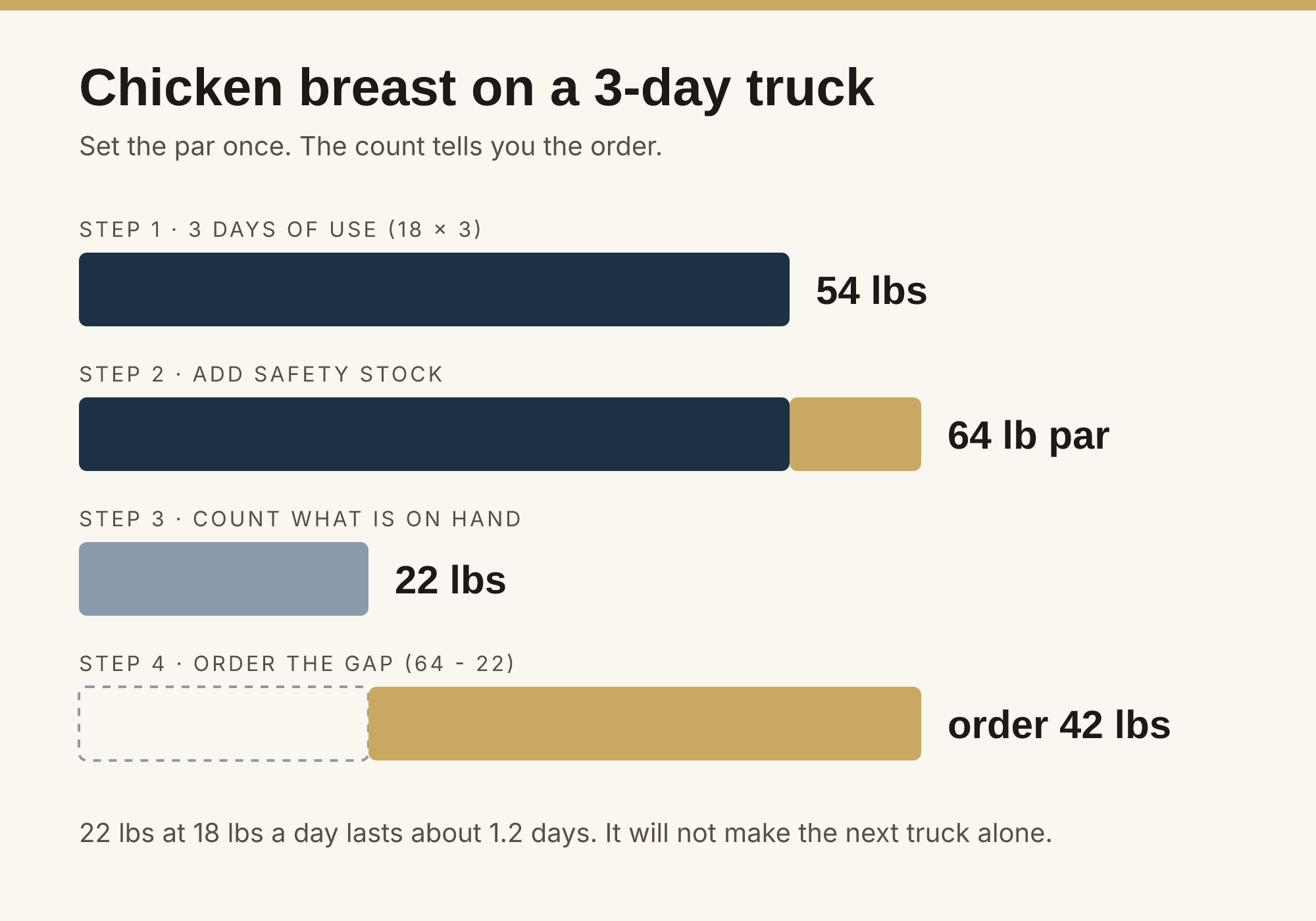 One item, start to finish: set the par once, then the count tells you the order.
Once the par is set, counting is the daily job. That is where a Par Level Tracker your crew counts on a tablet at the walk-in takes the clipboard out of it: each person logs in with a PIN, counts against the par, and the shortfall list lands in your email when they submit.
How to get average daily use without guessing
The par is only as good as the usage number, and this is where most pars go wrong. A few rules from the floor:
- Use 2 to 4 weeks of history. One week can be skewed by a catering order or a slow stretch. More than a month back can miss a menu change.
- Divide by days open, not calendar days. If you are closed Mondays, a 28-day stretch is 24 days of use.
- Count in the unit you order in. If chicken comes in 40 lb cases, you can figure par in pounds, but write the order in cases so nobody has to convert at 10 p.m.
- Pull it from what you actually used, not from what the recipe says you should use. Trim, waste, and the cook who portions heavy all count against the shelf. If the item gets trimmed or cooked down before it hits the plate, run it through the yield calculator for raw versus usable weight first so you are not short every Friday.
Set safety stock on purpose
Safety stock is the part people either skip or pad until the walk-in is full. A commonly cited range is about half a day to one day of usage. In the example, 10 lbs is a little over half a day of chicken.
Push it higher when:
- The item runs out often, and running out hurts (your top seller, a protein, fryer oil).
- The vendor is late or shorts the order more than once in a while.
Pull it lower when:
- The item has a short shelf life (greens, fresh fish, cut fruit).
- You can get it same day from a backup supplier if you have to.
If you keep landing well above par on the same item every order day, the par is too high and that extra product is on its way to the trash.
Friday's par is not Monday's par
A delivery that carries you through Friday, Saturday, and Sunday covers your three heaviest days. A Monday delivery does not. Same item, different par.
Say weekend chicken use runs 26 lbs a day instead of 18. A Friday truck covering 3 weekend days with half a day of safety stock (13 lbs) works out to 26 x 3 + 13 = 91 lbs. Run the formula once per delivery window, with the usage for the days that truck actually has to cover.
This is how I look at it as a GM:
When I look at par levels, I'm looking at what we're actually using, what day of the week it is, what's coming up, and what keeps getting thrown away. Friday's par shouldn't automatically be Monday's par.
The calculator can give me the number. My job as the GM is deciding whether that number makes sense for my restaurant.
What usually goes wrong
The math is easy. These are the places it breaks in a real kitchen:
- The par was set once and never touched. The menu changed, summer came, the new special doubled your use of one item, and the par sheet still says what it said in March. Look at pars whenever the menu or the season changes, or anytime the same item keeps running short or getting tossed.
- The count is a guess. "Looks like about half a case" is not a count. If the on-hand number is wrong, the order is wrong, no matter how good the par is.
- Nobody owns the item. If three people count the walk-in on three different nights, each one counts a little differently. Put a name on the count for each shift.
- Over par turns into "order some anyway." If the order comes out to zero, skip it. That is the formula working.
For how pars feed the daily prep sheet, see how to run a back of house prep list that keeps up with the rush.
A par sheet you can copy tonight
Print this, fill one row per item, and tape it to the walk-in door.
| Item | Order unit | Avg daily use | Days to next truck | Safety stock | Par | On hand | Order |
|---|---|---|---|---|---|---|---|
| Chicken breast | lbs | 18 | 3 | 10 | 64 | 22 | 42 |
How to use it:
- Fill in the first five columns once, from your last 2 to 4 weeks.
- Figure par with the formula, or check each row with the par level calculator.
- On order day, write the count in "On hand" and subtract.
- Anything at or above par gets a zero. Do not round up out of habit.
- Once a month, look at the rows that ran short or got thrown out and adjust those pars first.
Stop counting on a clipboard
The formula sets the par. The hard part is getting an honest count every night and seeing the shortfalls before the order goes in, not after the truck leaves.
The Par Level Tracker is built for that piece. Your crew counts by PIN on a tablet at the walk-in, and the list of what is short gets emailed to you the moment they submit. It is $12 a month with a 14-day free trial, so you can run it alongside your paper sheet for two weeks and see which one you trust more.
Frequently asked questions
How do you calculate par levels for a restaurant?
Multiply your average daily use of an item by the number of days until the next delivery, then add safety stock. That is your par. Subtract what you have on hand to get what to order. For example, 18 lbs a day times 3 days plus 10 lbs of safety stock is a 64 lb par, and with 22 lbs on hand you order 42 lbs.
What is the formula for par level?
Par equals average daily use times days between deliveries, plus safety stock. Order amount equals par minus what is on hand, and never goes below zero.
How much safety stock should a restaurant keep?
A commonly cited range is about half a day to one full day of usage. Keep more on items that run out often or come from a vendor who is late a lot, and less on anything with a short shelf life.
How do I find average daily use for par levels?
Take what you used of the item over the last 2 to 4 weeks and divide by the days you were open. Use the same unit you order in, whether that is pounds, cases, or each.
Should par levels change by day of the week?
Usually yes. A delivery that has to carry you through Friday, Saturday, and Sunday covers heavier days than a Monday delivery. Figure the par with the usage for the days that specific delivery covers.