How to Run a Back of House Prep List That Beats the Rush
A restaurant prep list for back of house that keeps up with the rush. Real steps to set pars, assign prep, and stop running out mid-shift.
Your line runs out of a key item at 6:45 on a Friday. Somebody sprints to the walk-in, there's nothing prepped, and now a cook is dicing onions while a full rail of tickets stacks up. That's not a people problem. That's a prep list problem.
Most back of house prep lists are a laminated sheet that hasn't changed in a year. It doesn't know what sold yesterday, it doesn't know a big catering order is going out at 5, and it never tells anyone how much to make. So the kitchen guesses. Guessing high wastes food. Guessing low blows up the rush.
Here's how to build a prep list that actually holds up when it gets busy. You can put most of this in place before your next shift.
Start with par levels, not a wish list
A prep list without par levels is just a to-do list with no finish line. "Prep chicken" means nothing. "Have 40 portions of chicken ready by 4:30" means something.
A par level is the amount of a prepped item you want on hand when service starts. Every line on your prep list needs one. Build the first version like this:
- List every item the kitchen preps by hand. Sauces, portioned proteins, cut produce, batters, dressings, par-cooked items, all of it.
- For each one, write down how much you went through on a normal busy day. Ask the cooks who actually run it, they know better than the office.
- Add a small cushion for your busiest realistic night, not your record night.
- That number is your par.
Do not set pars from memory or from what the last GM wrote down. Set them from what you actually use.
Count what's left before you prep anything
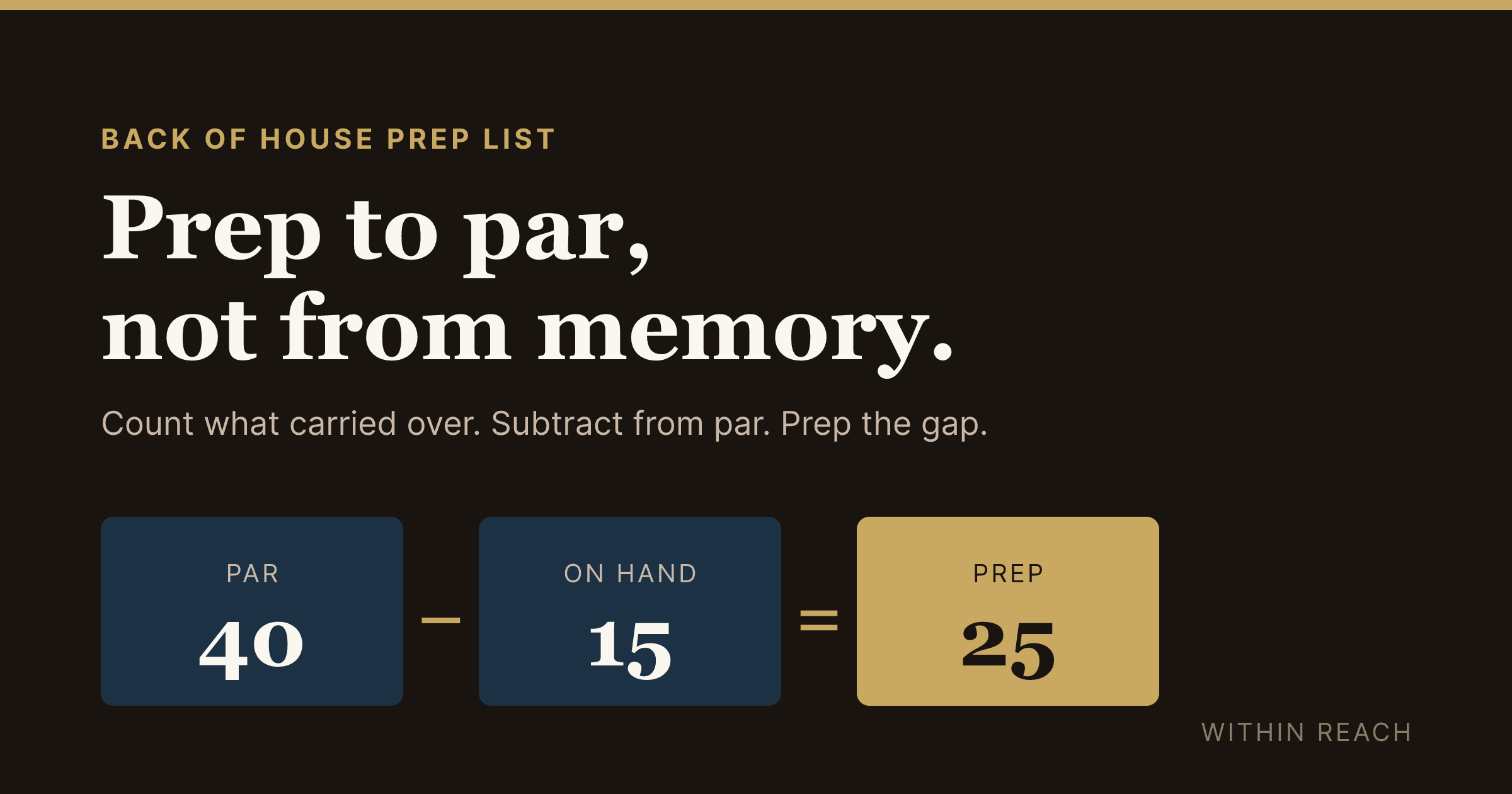
The single biggest mistake in back of house prep is prepping to par without checking what carried over. If your chicken par is 40 portions and you have 15 left from yesterday, you prep 25, not 40. Skip the count and you double up, run out of cooler space, and toss product in three days.
Every shift, before anyone starts prepping, one person walks the line and the walk-in and counts on-hand for each item. Then the math is simple:
Prep amount = par level minus what's on hand.
That's the whole formula. Par minus on-hand equals the gap you prep. When the gap is zero, you skip it and move on. When it's negative, you're carrying too much and your par might be high.
Assign every item to one name
A prep list where "the kitchen" owns everything is a list where nothing gets owned. Items fall through because everybody assumed somebody else had it.
Put a name next to every prep item for the shift. One person per line. The opening lead or a prep cook can own the whole board, or you split it by station, but each item has exactly one owner. When the sauce isn't ready at 4, you know whose lane it was, and you fix the process instead of yelling at the room.
This is also where a shift-level prep board earns its keep. If your team already runs a per-shift message thread, pin the prep list there so the whole crew sees the same assignments. Our writeup on running one message thread per shift covers that setup.
Sequence prep by when you'll need it
Not everything needs to be ready at open. Sequencing prep by service time keeps cooks from burning the morning on items that don't get touched until dinner while the lunch rush items sit undone.
Group your prep into three simple tiers:
- Open-critical: needed before the first ticket. Anything on the lunch line.
- Mid-day: needed before the dinner turn. Restocks, second batches, dinner-only items.
- Slow-time projects: big batch items, next-day prep, deep cleans that only happen when it's quiet.
Order the list top to bottom in that sequence. The board reads like the day runs, so a cook works down it and is always ahead of the rail instead of behind it.
Build a par sheet you can copy and use today
You don't need software to start. Here's a prep par sheet you can copy into a spreadsheet or print for the wall right now. Fill in your items and your numbers.
BACK OF HOUSE PREP SHEET
Date: __________   Shift: __________   Owner: __________

ITEM                | PAR | ON HAND | PREP (PAR - ON HAND) | ASSIGNED TO | DONE
--------------------|-----|---------|----------------------|-------------|-----
[Open-critical]
Portioned protein   |  40 |         |                      |             | [ ]
Cut produce         |  12 |         |                      |             | [ ]
House sauce         |   6 |         |                      |             | [ ]
--------------------|-----|---------|----------------------|-------------|-----
[Mid-day]
Second batch protein|  30 |         |                      |             | [ ]
Dinner-only item    |  20 |         |                      |             | [ ]
--------------------|-----|---------|----------------------|-------------|-----
[Slow-time projects]
Next-day batch      |  50 |         |                      |             | [ ]

Notes / 86 risk: ____________________________________________
Rules for the sheet:
- On-hand gets counted, never estimated.
- Prep column is always par minus on-hand. If a cook is prepping a different number, ask why.
- One owner per row.
- The notes line flags anything at risk of running out so the next shift sees it coming.
Print it, run it for two weeks, and you'll spot which pars are wrong fast. Items you always over-prep have a par set too high. Items you always run out of are set too low.
Adjust pars from real usage, not vibes
A prep list is only as good as its pars, and pars drift. Traffic changes, a new menu item lands, an LTO hits, the season turns. Pars you set in January are wrong by April.
Review your pars every two to four weeks. The read is simple: look back at how much you actually used against what you prepped. Consistently prepping 40 and using 28 means your par is high, drop it. Consistently running out means it's low, raise it. This is the same discipline behind a good daily ops routine, where the shift report tells you what actually happened instead of what you hoped happened.
The trap is doing this by hand. Counting yesterday's usage, comparing to par, and re-figuring every item across a full menu every couple weeks is real work, and it's the first thing that gets skipped when you're busy. Which is exactly when your pars go stale.
Let the counts do the math for you
Everything above works on paper. It works better when the counting and the usage math run themselves.
That's what Par Level Tracker does. Your crew counts on-hand on a tablet, and it tracks daily par levels and gives reorder suggestions based on what you actually used yesterday. No spreadsheet re-figuring, no guessing which pars drifted. It works offline too, so a spotty walk-in signal doesn't stop the count. The manual work in this whole article, counting, subtracting from par, spotting which items keep running short, is the part it takes off your plate so the prep board stays honest without someone babysitting it.
Par Level Tracker is part of the starter suite if you're setting up the rest of your back of house at the same time.
Start with the par sheet above this week. Once counting to par is a habit, put it on the tablet and stop running out at 6:45.
Frequently asked questions
What is a back of house prep list?
A back of house prep list tells the kitchen what to make before service and how much of each item to have ready. It pairs every prep item with a par level, the target amount you want on hand when the rush hits, so nobody guesses.
How do you set par levels for prep?
Set pars from your actual usage on comparable days, not from memory. Look at how much of an item you went through last Friday, add a small buffer for a busy night, and make that your par. Adjust it every few weeks as sales shift.
Why does my kitchen keep running out of prep during the rush?
Usually the prep list is a static sheet that never changes and doesn't account for what actually sold. When pars are guessed and nobody counts what's left from yesterday, you either run out mid-rush or over-prep and throw food away.
Who should own the prep list?
One person per shift owns it, usually the opening lead or a designated prep cook. They count on-hand, compare against par, and assign the gap. Ownership by one name per shift is what keeps items from falling through the cracks.
How often should you update prep pars?
Review pars every two to four weeks and after any real change in traffic, a menu update, a new LTO, a seasonal swing, or a schedule shift. Pars set once and never touched are the reason lists drift out of reality.