How to Calculate Yield Percentage for Meat Before You Set a Par
How to calculate yield percentage for meat: usable weight over purchased weight. Worked 10 lb brisket example, true cost per pound, and a yield test sheet.
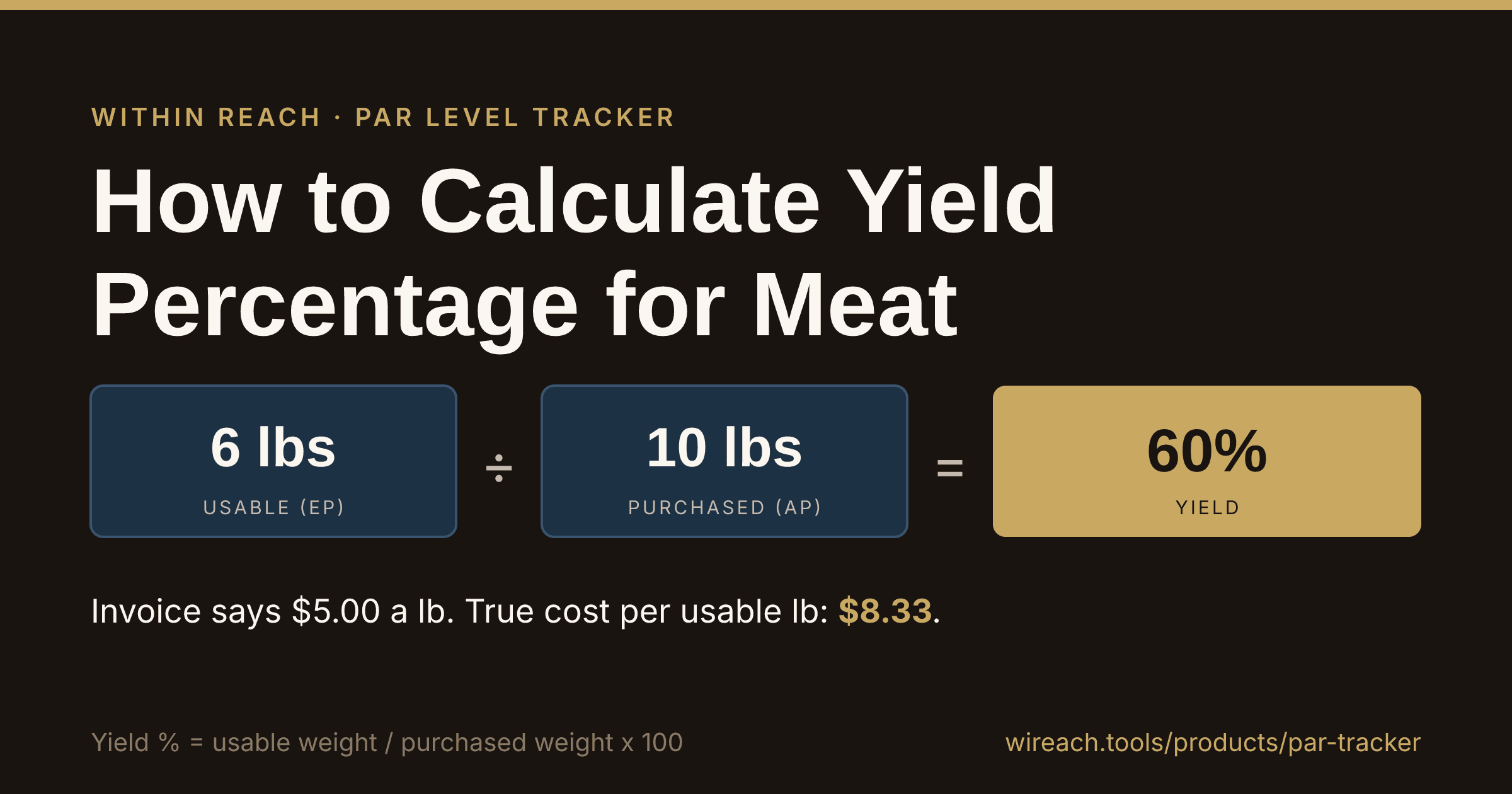
The invoice says $5.00 a pound. That is not what the brisket costs you. By the time it is trimmed and cooked, a big piece of what you paid for is in the trash can or the drip pan.
Yield percentage tells you how much of what you bought you can actually serve. Get it wrong and two numbers go bad at once: your plate cost reads too low and your par is too short. This walks through how to calculate yield percentage for meat, one brisket carried from the receiving scale to the cutting board, and a test sheet you can run on your next delivery.
The yield formula
Three numbers, all in pounds and dollars:
- Yield percent = usable weight (EP) / purchased weight (AP) x 100
- True cost per usable lb = invoice price per lb / yield as a decimal
- Hidden cost per lb = true cost per usable lb - invoice price per lb
AP is as purchased, the weight on the invoice or the scale when the case comes in. EP is edible portion, what is left after you trim, cook, and portion it the way your line actually does.
If you want the math done for you, run your numbers in the free yield calculator. It gives you yield percent, true cost per usable pound, and how much more you are paying per pound than the invoice shows.
A worked example: one 10 lb brisket
Here is one brisket carried all the way through. These are the same numbers the calculator loads with, so you can check each line.
| Input | Amount |
|---|---|
| Purchased weight (AP) | 10 lbs |
| Invoice price | $5.00 per lb |
| Total paid | $50.00 |
| Usable weight after trim and cook (EP) | 6 lbs |
Step by step:
- Total paid: 10 x 5.00 = $50.00
- Yield: 6 / 10 = 0.60, times 100 = 60%
- True cost per usable lb: 5.00 / 0.60 = $8.33
- Hidden cost: 8.33 - 5.00 = $3.33 more per lb than the invoice says
Check it the long way: you paid $50.00, lost 4 lbs to trim and cooking, and got 6 lbs you can serve. 50.00 / 6 = $8.33. Same answer.
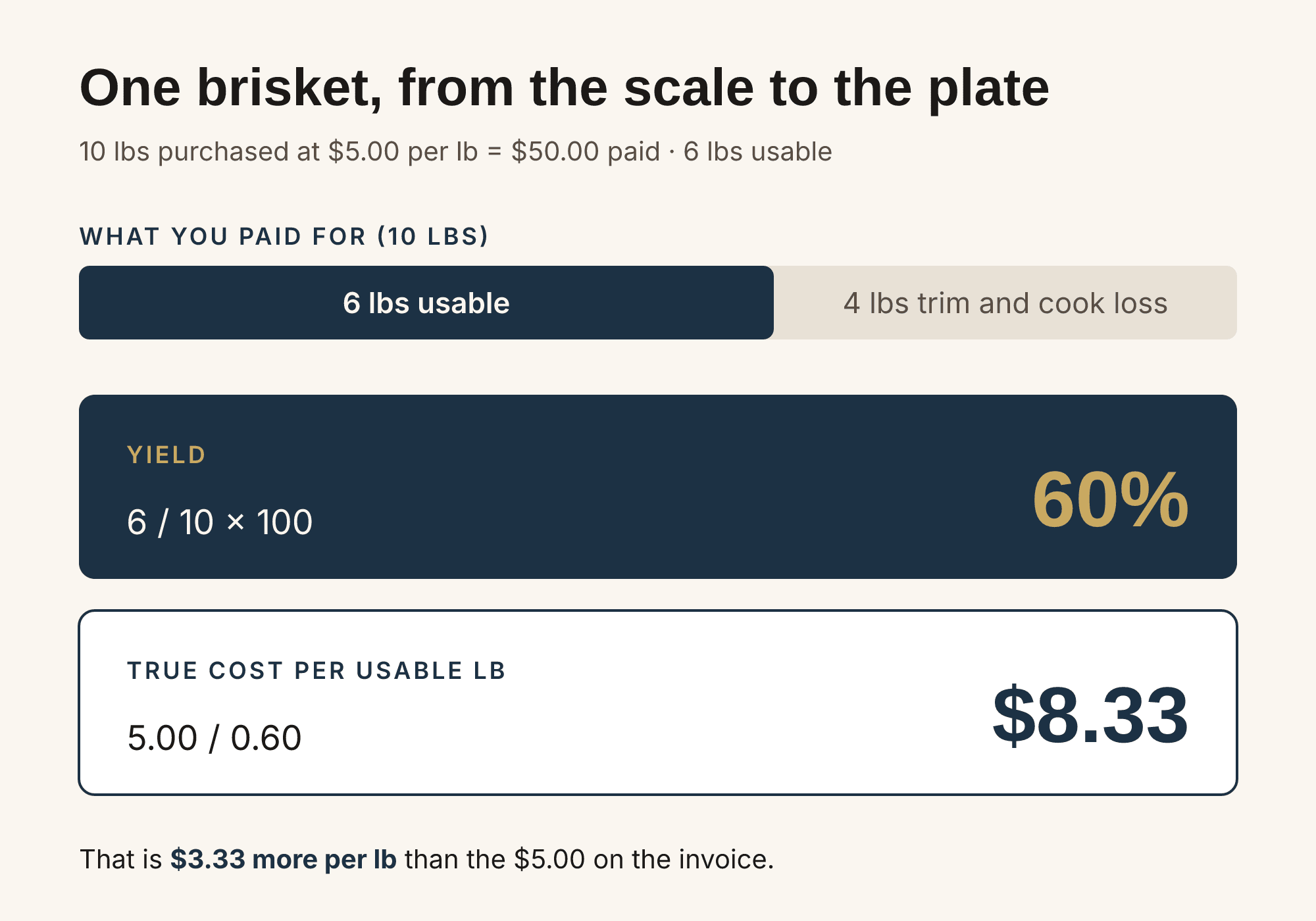 The invoice price is what you paid. The true cost is what you served.
That $3.33 is the number most kitchens never see. It is trim, fat, moisture lost in the smoker, and the end pieces that never make a plate. Cost a sandwich at $5.00 a pound and it looks like it makes money. Cost it at $8.33 and you might find out it does not.
Turn yield into a par that does not run short
This is where yield bites the order. Your crew uses brisket in cooked, sliced pounds. You buy it in raw pounds. If the par is set off what you serve, you will run out every time.
Say you serve 6 lbs of cooked brisket a day and your truck comes every 3 days. That is 18 usable lbs between deliveries. At 60% yield:
- Raw pounds needed: 18 / 0.60 = 30 lbs as purchased
- What happens if you forget yield: you stock 18 lbs raw, cook it down to about 10.8 usable lbs, and you are out before the second day is over
So the par goes on the shelf in AP pounds, built from the EP pounds you use. If you have never set a par from usage before, work out the base number in the free par level calculator, then divide the usable amount by your yield before you write it on the sheet.
Once the par is right, the daily job is counting against it. A Par Level Tracker your crew counts on a tablet at the walk-in has each person log in by PIN, count against the par you set, and emails you the shortfall list the moment they submit. The yield work is what makes that par worth counting against.
How to run a yield test
One test is a guess. Three is a number. Do it like this:
- Weigh it at the door. Put the whole piece on the scale before anybody touches it. Write down the weight and the price per pound from the invoice.
- Trim it the way the line trims it. Not the way the chef does it on a good day. The way it really goes on a Tuesday.
- Cook it the normal way. Same temp, same time, same equipment.
- Weigh what can be served. After slicing or portioning. Leave out the end pieces if they never go on a plate.
- Do the math and write the yield next to the date and who ran the test.
- Repeat on the next two deliveries and use the average.
If the case price is all you have, divide it by the case weight to get price per pound first.
What usually goes wrong
Weighing after the trim. Somebody preps the piece first and weighs it later. Now your AP number is already missing the fat cap and you get a yield that looks great and means nothing. Weigh it the second it comes off the truck.
Testing once and treating it as law. One brisket can run fattier than the next. One test on a good piece sets your par short for every piece that is not as good.
Buying on invoice price. The cheaper case per pound can cost more per usable pound. If one vendor's piece yields 60% at $5.00 and the other yields better at a higher price, the only way to know which is cheaper is to compare true cost per usable pound, not the price on the sheet.
Costing the plate at AP. The portion on the plate is usable product. Cost it at the true cost. Our walkthrough on costing a plate the way the line builds it shows where that number goes.
Here is how the person who built the calculator looks at it:
Yield isn't something I deal with much in my current restaurant because our menu is limited. Earlier in my career, food cost wasn't managed the way it is in a traditional restaurant.
But I know plenty of operators have to watch it closely, which is why I wanted this calculator available.
The price you pay for a case isn't necessarily the cost of what you can actually serve. Trimming, cooking, bones, fat, moisture loss, and waste can all reduce the amount of usable product you're left with.
That's where yield matters. If you're only looking at the purchase price, you may think an item costs less than it really does.
This isn't a calculation I personally use every day. It's a tool I built for the manager who does.
A yield test sheet you can copy
Tape it next to the receiving scale. One row per test.
| Date | Item and vendor | AP lbs | Price per lb | Total paid | EP lbs | Yield % | True cost per usable lb | Tested by |
|---|---|---|---|---|---|---|---|---|
| Example | Brisket | 10 | $5.00 | $50.00 | 6 | 60% | $8.33 | |
How to use it:
- Fill the first five columns at receiving, before the product goes in the walk-in.
- Fill EP after cooking and portioning, the same day.
- Check the math in the yield calculator for AP to EP cost before you file it.
- After three tests, average the yield and use it for your par and your plate cost.
- Retest when anything changes: new vendor, new cut, new cook time, or the yield on the line starts feeling off.
Count against a par that matches your yield
Yield fixes the par. Counting keeps it honest. If the count lives on a clipboard that gets filled in at 10 p.m. by whoever is closest, a short par and a missed count look exactly the same when you run out on Saturday.
The Par Level Tracker puts par counts on a tablet at the walk-in. Your crew counts by PIN, and the shortfall list emails you on submit, so you know what is short before the order goes in. It is $12 a month with a 14-day free trial, so you can run your new yield-based pars through it for two weeks and see if the Saturday run-outs stop.
Frequently asked questions
How do you calculate yield percentage for meat?
Divide the usable weight after trimming and cooking by the weight you bought, then multiply by 100. A 10 lb brisket that gives you 6 lbs you can serve is 6 / 10 = 60% yield.
How do you find the true cost per usable pound?
Divide the invoice price per pound by the yield as a decimal. Brisket at $5.00 per lb with a 60% yield costs 5.00 / 0.60 = $8.33 for every pound you actually serve.
What do AP and EP mean?
AP is as purchased, the weight you pay for on the invoice. EP is edible portion, what is left that you can serve after trimming, cooking, and waste.
What is a normal yield for meat?
It depends on the cut and how you prep it. Commonly cited ranges run from roughly 50% to 70% for many cooked, trimmed meats. Your own tests on your own product beat any chart.
Why does yield matter for par levels?
Your par is counted in what you buy, but your usage is what you serve. If you need 18 usable lbs and your yield is 60%, you have to stock 30 lbs as purchased, not 18.